
A potager is an ornamental kitchen garden where vegetables, herbs, and flowers grow together in geometric beds that feed both your table and your eye.
The style only works if you commit to its symmetry: raised beds no wider than 4 feet, arranged around paths wide enough for a wheelbarrow turn, with a central focal point pulling the whole composition together.
At Villandry, the Renaissance gardeners still run two full plantings a year through those patterned beds, proving the framework has held since the Middle Ages.
What a Potager Garden Is

A potager is an ornamental kitchen garden: vegetables, herbs, fruits, and flowers grown together so the bed feeds your table and your eye at once.
The word itself comes from medieval French and translates directly to "for the soup pot," which tells you exactly what these gardeners prioritized. Practical harvest, practical name.
What separates a potager from a standard vegetable plot is intentionality about form. Medieval monastery gardens laid out beds in geometric patterns inspired by religious symbols, and that symmetry stuck.
The design made plants accessible from every side without trampling soil, and the orderly layout let gardeners reach, weed, and harvest efficiently. Beauty was never an afterthought; it was built into the grid.
I think the distinction matters for anyone working a small space.
A vegetable plot asks how much food you can pull from a square foot. A potager asks the same question, but adds whether you actually want to look at it while the food grows.
The French have been refining that balance since the Middle Ages, and the framework still holds: edibles arranged with the same care you’d give a flower border, because they are the flower border.
Symmetry and Layout
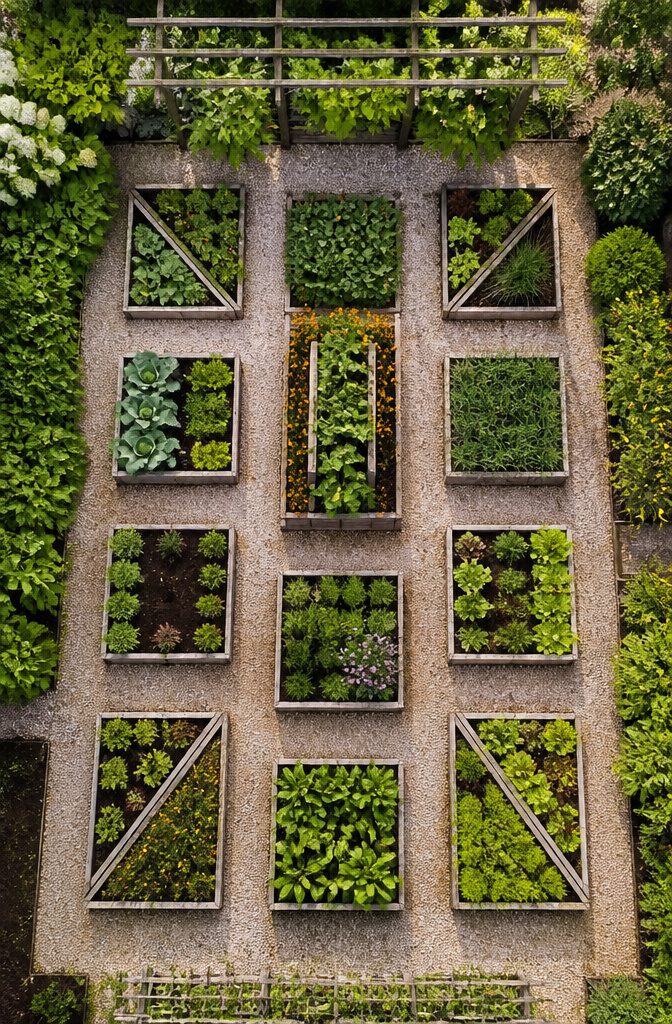
A potager garden plan lives or dies on its geometry. The beds should sit in a symmetrical pattern, grid-style or shaped into Ls, triangles, and rectangles around a central point.
That symmetry is not decoration; it is the structure that lets the garden read as one intentional space rather than a collection of vegetable patches.
Raised beds need to stay no wider than 4 feet if you want to tend and harvest from both sides without stepping into the bed itself.
Reach from one side only, against a fence or wall, and 2.5 feet is the practical ceiling, about as far as an arm extends.
A path narrower than 18 inches forces you to step into the bed every time you weed or harvest, compacting the soil you just loosened.
In practice, you need enough room to kneel or stand between beds with a harvest basket and a pair of shears, and to turn a wheelbarrow at the corners without crushing a corner planting.
The layout serves two masters at once. Walk the paths and you are moving through a designed space, the beds rising on either side like hedges in a small enclosure.
Work the beds and the same geometry means every plant is within arm’s reach, no center trampled by a gardener stretching too far. Function and form are not balanced here; they are the same thing seen from two angles.
Planting for Year-Round Production

A potager garden only earns its keep if the beds never sit empty. Succession planting fills each gap the moment a crop finishes, so the soil stays productive and the visual rhythm keeps going through the season.
At Villandry, the gardeners run two full plantings: one from March through June, another from June into November. The layout itself changes with each turn, partly to rotate crops and partly to keep the color harmony alive.
Perennials need placement with care.
Small fruit trees traditionally line the edges along paths and walls, with strawberries or annual herbs tucked at their feet. Mint and tansy stay contained, since aggressive herbs will swallow a bed meant for rotation.
Annual herbs and flowers mix straight in with vegetables, and some pairings earn their spot twice over: coriander among carrots, for instance, to deter carrot fly.
The constant replanting means a potager looks different in October than it did in May. That is the design working as intended.
I would rather see a bed of spent lettuce get turned for fall greens than hold the same layout because it photographs well. The garden stays a kitchen garden first, and the beauty follows from the use.
What to Plant

A potager garden runs on plants that earn their square footage twice over. Swiss chard varieties like Bright Lights carry jewel-toned stems that read as flower color from the path, then land in your skillet the same evening.
Nasturtiums pull the same double shift: peppery edible flowers that also blanket soil edges and repel a host of pests. I would not build a bed without them.
Basil tucked against tomatoes is the pairing I plant first every season. The basil sharpens the tomato’s flavor and the foliage helps deter aphids and whiteflies that cluster on the stems.
Garlic or chives along a carrot row do similar work against carrot root fly, and the allium fringes look sharp against the ferny tops.
The rule I follow is simple: every plant feeds your eye or your kitchen, and the best do both at once.
French marigolds with citrus-toned blooms, poached egg flower drawing pollinators, coriander masking carrot from fly: these are not decorations added after the food crops are placed.
They are structural choices that keep the garden producing and keep it from looking like a farm plot crammed behind a house.
Cosmos and sunflowers belong here too, not tucked off to the side but mixed in as working members of the bed.
The geometry of a potager demands that every plant pull weight visually; the harvest is simply the bonus that makes the weeding worth it.
Vertical Elements
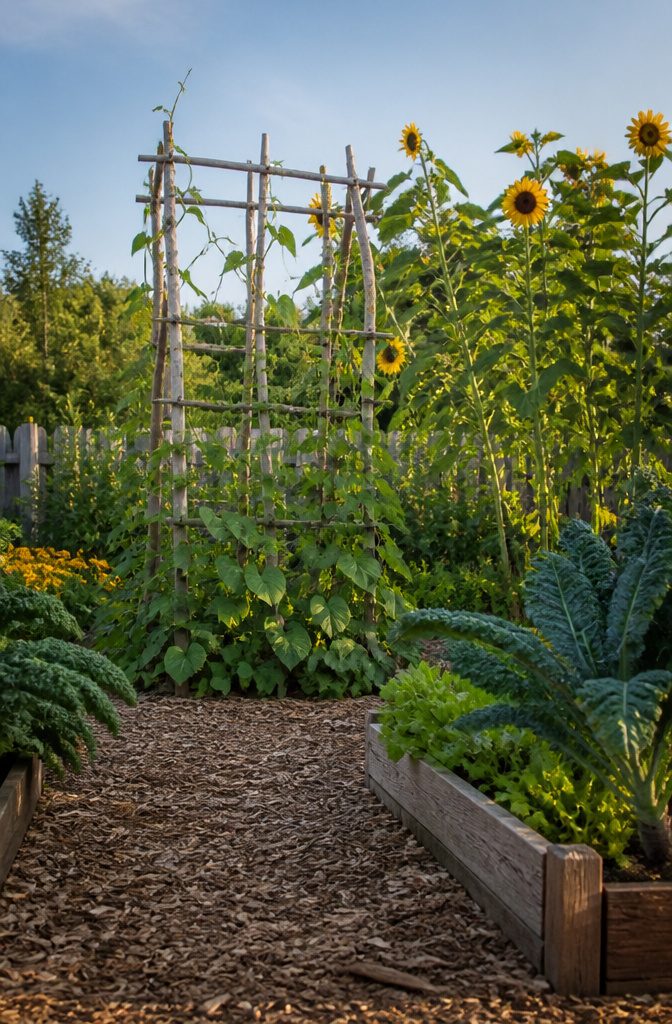
Trellises, arches, and obelisks turn a flat vegetable patch into a garden with real structure.
In a potager garden plan, vertical elements define bed edges and pathways without needing a fence or hedge, which matters when space is tight and permanence is not an option.
A 16-foot cattle panel bent into an arch between two beds costs little and creates a tunnel strong enough for tomatoes or beans.
I would secure it to rebar driven into the ground with wire or zip ties; by midsummer the structure disappears under growth.
For a freestanding wall, the same panel stood upright and clipped to stakes gives cherry tomatoes the air circulation that keeps fruit clean and picking easy.
Metal obelisks sit well at bed corners or path intersections.
They read as formal from a distance while supporting peas, morning glories, or climbing beans. Hazel, willow, or bamboo can substitute if the budget is closer to zero, though the finished shape is looser.
The rhythm these create is what separates a potager from rows of vegetables. An arch every third bed, an obelisk at each corner, and the eye has a reason to travel.
I would skip the pergola unless the garden is large enough to carry the shadow it throws; for most weekend projects, the lighter structures do more work with less weight.
Focal Points
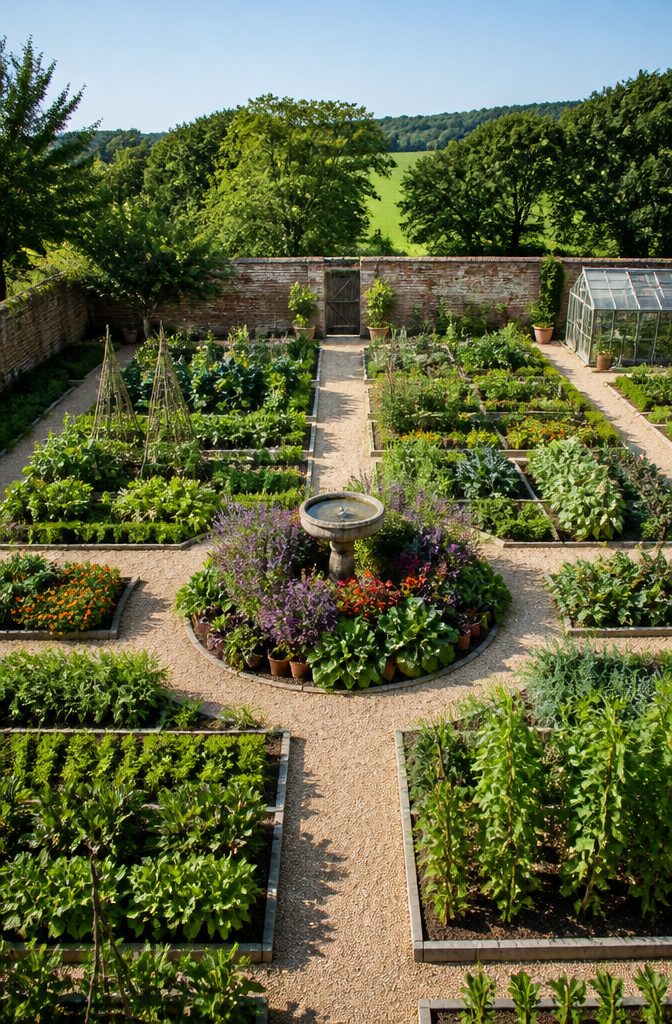
Gravel paths in a formal potager pull the eye straight to the center, which makes that spot the natural place for a single piece that rewards the walk toward it.
A sundial, a birdbath, or a small fountain all work; so does a fruit tree standing alone in its own raised bed or a large container.
I would pick the tree or the water feature over a sculpture every time, because either one gives you sound or seasonal change that a static piece cannot match.
An obelisk trellis covered in vines, a pergola clothed with climbers, or even a single bold plant like a globe artichoke or scarlet runner bean can serve the same purpose if a hardscape piece feels too permanent for your situation.
The point is not the object itself but what it does for the geometry.
A strong center breaks the grid of beds into a composition your eye travels through rather than merely across, and it gives the viewer a place to rest.
Without that rest, a potager reads as productive ground and nothing more. Add it, and the vegetables become the setting for something beautiful, which is the whole reason this garden style exists.
Historical Example
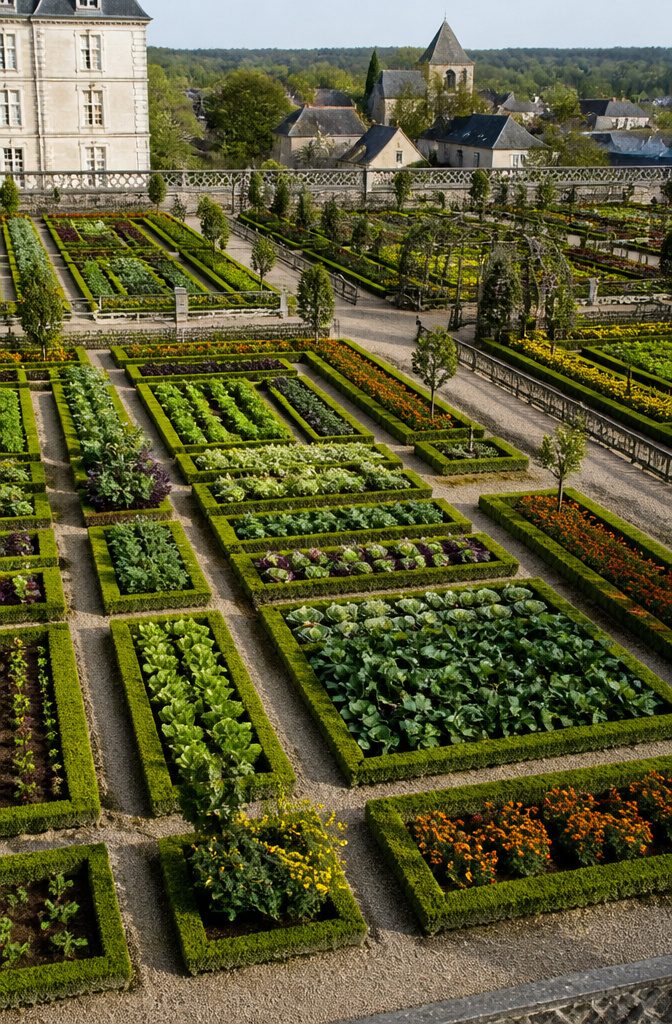
The Château de Villandry carries the most significant surviving example of traditional potager garden design, and walking its beds clarifies what the French Renaissance actually intended.
The garden arranges vegetables, herbs, and flowers into intricate geometric patterns visible from the château windows above, so the design serves two audiences at once: the cook harvesting below and the observer taking in the symmetry from a distance.
That dual purpose sits at the heart of the potager form, not as a later refinement.
What strikes me most is the tension between that formal beauty and real workability. The beds at Villandry run wider than the 4-foot rule most gardeners follow for easy reach from the sides.
The gardeners there manage it by defining narrow walking paths inside the larger beds with hay or wood chips, or by simply stepping onto the soil when tending it.
The compaction is real but limited if foot traffic stays occasional. For a weekend project on a rental or first home, I would stick to the 4-foot maximum and keep the geometry through the overall layout instead.
The pattern matters more than the bed size for getting that Renaissance look, and narrow beds are what make the pattern achievable without a grounds crew.
Keeping It Productive
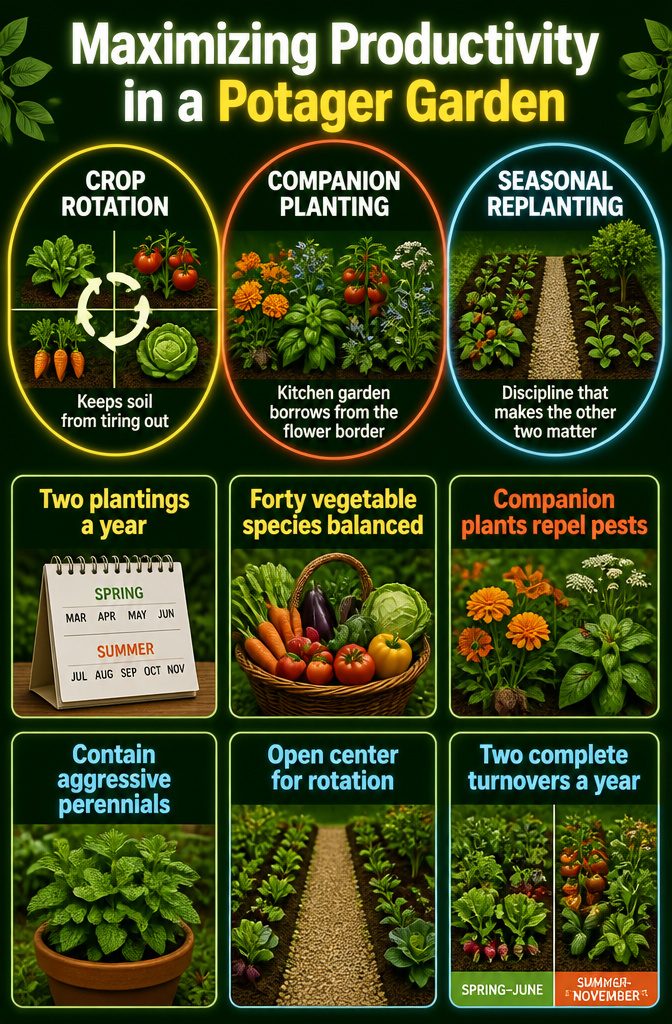
A potager stays productive through three practices that sound more technical than they are.
Crop rotation keeps the soil from tiring out. The gardens at Villandry run two plantings a year, spring through June and summer through November, with the layout shifting each time to keep forty vegetable species in balance.
That kind of turnover is easier to manage in a small space than it sounds, and the color changes are a side benefit I would not skip.
Companion planting is where the kitchen garden borrows from the flower border.
Nasturtiums and marigolds edge vegetable beds and repel enough pests to earn their keep. Coriander planted among carrots deters carrot fly; basil near tomatoes improves flavor and cuts aphid pressure.
Borage helps squash and strawberries, while flax protects root vegetables from soil-level pests. What the literature does not spell out is how these pairings handle specific pest outbreaks in a potager setting.
The general benefit is well documented, but I would not count on companion planting alone if carrot fly or whitefly has already moved in.
Seasonal replanting is the discipline that makes the other two matter.
Aggressive perennials like mint need containing so they do not take over beds meant for annual vegetables. Small fruit trees traditionally sit at the edges, along paths or walls, with strawberries or annual herbs at their feet.
The center stays open for the rotation. Two complete turnovers a year is the working standard, and anything less leaves the soil and the gardener both resting more than they should.
Design Considerations
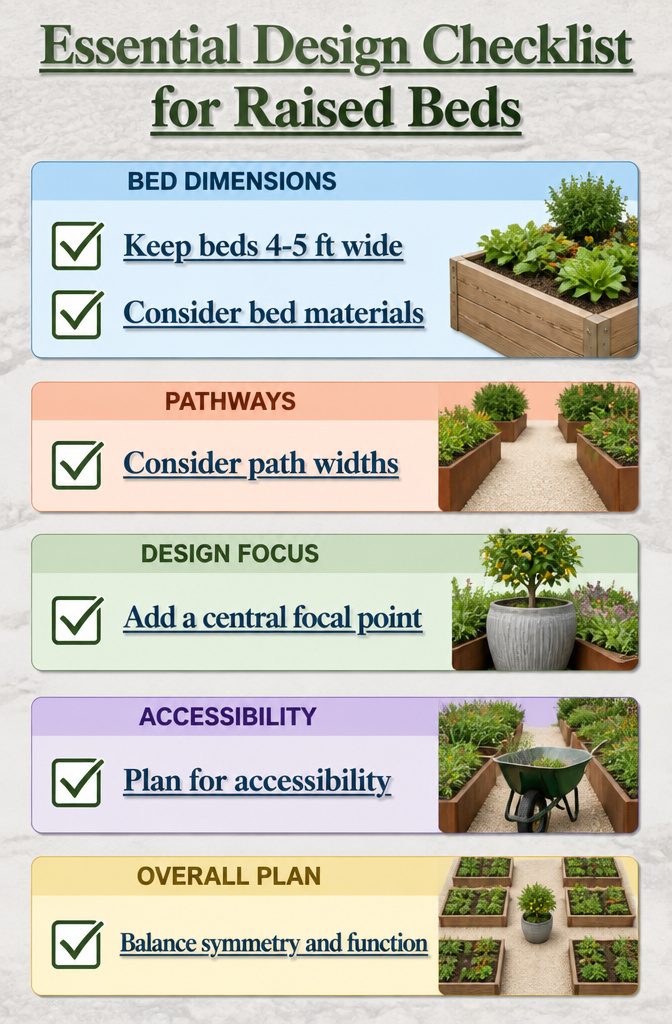
Raised beds give you control over soil and drainage that in-ground planting rarely matches, especially if your site has heavy clay or shallow topsoil.
Wood, Corten steel, or powder-coated metal each frame the geometry differently, and the material choice matters less than getting the dimensions right.
Keep beds no more than four to five feet wide if you can walk around every side, which lets you tend and harvest the center without stepping into the bed and compacting the soil.
Back a bed against a fence or wall and the workable width drops to about two and a half feet, roughly an arm’s reach, or you will lean and trample more than you mean to.
Symmetry tends to govern the overall plan: L-shaped, triangular, or rectangular beds arranged around paths in a repeating pattern. The paths are not afterthoughts.
They carry the wheelbarrow, the harvest basket, and your own feet through every season, and their width and surface decide whether the garden feels like a working plot or a space you actually want to walk through.
I would trade a perfectly mirrored quadrant for paths I can kneel on and turn a cart in, but the two are not mutually exclusive if you measure before you build.
A central focal point, even something as simple as a large planter or a small fruit tree, gives the eye a destination and makes a sizable yard feel enclosed rather than exposed.
Aesthetic Choices

Ornamental edibles are the first move that separates a potager from a standard kitchen garden.
Ruby chard, purple basil, and lacinato kale read as foliage plants from a distance, so I use them exactly where a conventional border would call for coleus or ornamental grass.
The color blocking comes next, and I think of it the way the Renaissance designers at Villandry still do: cool-season crops in one quadrant, warm-season in another, so the eye finds a pattern even when individual plants rotate.
Scarlet runner beans against blue borage, or golden zucchini framed by deep red salvias, give the saturation that reads as intentional rather than accidental.
Hardscape carries the formal character. Low boxwood or lavender hedges, clipped to 12–18 inches, edge beds into geometric shapes that hold their structure through winter when the interior planting is bare soil or mulch.
Gravel paths in a pale tone reflect light and keep the geometry legible even on overcast days. Weathered urns, olive jars, or a simple finial at an intersection do the work of sculpture without requiring a separate flower border.
The cost is maintenance: those clipped edges need three or four passes a season, and an informal cottage mix would forgive the skipped week.
I would still choose the edge, because without it the garden collapses into a kitchen plot the moment the tomatoes finish.
Starting From Real Conditions

Most potager garden plans assume flat ground, full sun, and permission to dig.
Few renters and first-home owners get all three. The actual starting point is usually sloped lawn, a balcony slab, or a backyard the landlord controls with a clause in the lease.
Raised beds solve more problems than they create, but the material choice is where the budget bites.
Wood keeps the cost within a weekend project; Corten steel or powder-coated metal last longer but cost enough that I’d only go there if the beds are staying when I move.
For a rental, wood raised beds you can disassemble and take with you win outright.
Ground-level beds work fine if the soil drains and the sun hits at least half the day, though I’d skip the digging entirely if the ground is heavy clay or compacted construction fill.
Pathways are the other place to compromise without ruining the look.
Stone or pea gravel read more formal, but wood chips cost less and improve as they break down. I’d lay them thick enough to suppress weeds, then swap for pavers later if the garden stays put.
Partial shade is not the dealbreaker it looks like.
Root vegetables, Swiss chard, lettuce, and kale all produce in lower light, and the red-stemmed varieties give you the color potagers are supposed to have. Garlic and onions even earn their keep twice: the bulbs below, the flowers above.
The structure matters more than the plant list. Get the bed layout right, and the planting adjusts to whatever sun you actually have.
Frequently Asked Questions
What is a potager garden?
A potager is an ornamental kitchen garden where vegetables, herbs, fruits, and flowers grow together so the bed feeds your table and your eye at once.
The word comes from medieval French and translates directly to ‘for the soup pot.’ What separates a potager from a standard vegetable plot is intentionality about form: edibles arranged with the same care you’d give a flower border, because they are the flower border.
How do you design a potager garden?
A potager garden plan lives or dies on its geometry. Beds should sit in a symmetrical pattern, grid-style or shaped into Ls, triangles, and rectangles around a central point.
Raised beds need to stay no wider than 4 feet if you want to tend and harvest from both sides without stepping into the bed itself; against a wall, 2.5 feet is the practical ceiling.
You also need paths wide enough to kneel or stand with a harvest basket and to turn a wheelbarrow at corners.
What plants should I include in a potager garden?
Choose plants that earn their square footage twice over. Swiss chard varieties like Bright Lights carry jewel-toned stems that read as flower color from the path.
Nasturtiums provide peppery edible flowers that blanket soil edges and repel pests. Basil tucked against tomatoes sharpens flavor and deters aphids and whiteflies.
Garlic or chives along carrot rows work against carrot root fly. French marigolds, poached egg flower, coriander, cosmos, and sunflowers all pull visual and practical weight.
What is the 70/30 rule in gardening?
In general gardening contexts, this ratio sometimes refers to balancing edible and ornamental plantings, or soil composition, but the potager approach rejects that split: every plant feeds your eye or your kitchen, and the best do both at once.
What is the 5, 4, 3, 2, 1 gardening method?
It appears to be a separate planting system unrelated to potager garden design, which focuses instead on succession planting, companion planting, and seasonal turnover rather than fixed numerical ratios.