

I’ve hauled wet compost, river rock, and everything between across three properties. Dump carts win on capacity (6–12 cubic feet versus 2–3), unloading ease (tilt-and-dump beats shoveling every time), and stability (four wheels outperform wheelbarrows on uneven terrain).
Wheelbarrows excel in tight spaces, steep slopes, and precision placement where four wheels become problematic. Your terrain, load size, and back condition determine the real winner, and the following breakdown shows exactly how to choose.
Dump Cart or Wheelbarrow? 3 Questions to Choose Right
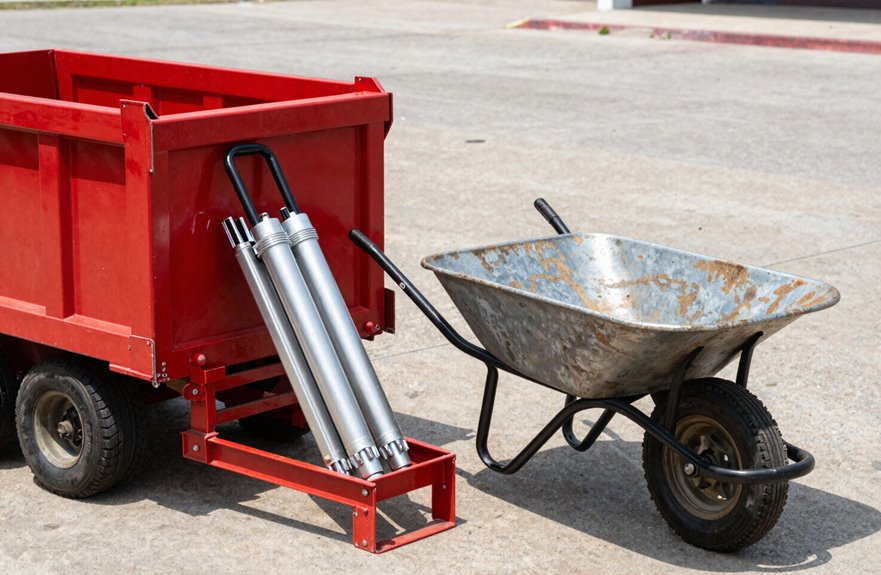
How do I know which one I’ll actually reach for on Saturday morning? It comes down to three honest questions about my actual life, not some fantasy farm.
First, what’s my hauling capacity reality? If I’m moving 6–12 cubic feet of mulch (that’s roughly 300–600 pounds), a dump cart’s stability wins on flat ground. But when I’m squeezing between raised beds or navigating my sloped driveway, a wheelbarrow’s slim profile and single-wheel maneuverability becomes essential.
Second, how’s my terrain suitability looking? Smooth lawn favors a dump cart. Steep, rocky, or narrow paths require a wheelbarrow.
Third, what’s my body telling me? The unloading mechanism matters. Tilting beats lifting. I check durability (steel for debris, plastic for light stuff), storage and space constraints (folding carts exist), and whether ergonomic handles justify the investment for heavy loads.
The Dump Advantage: Why Tilt-and-Dump Beats Shoveling
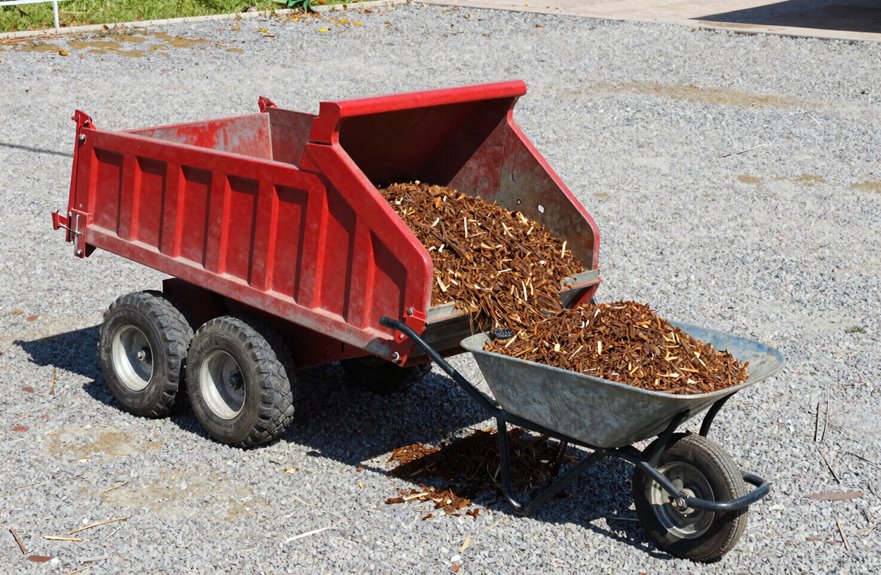
Once I’ve settled on a dump cart, the real payoff shows up at unload time. I’m done with the wheelbarrow shuffle. No more shoveling, no more back strain, no more wrestling sticky loads that cling like they’re paid to stay.
Wheelbarrow shuffle? Gone. Just lift, tilt, walk away clean.
Tilt-and-dump unloading works like this:
- The bed tips, gravity takes over, and six cubic feet of compost slides out clean
- My back stays straight while heavy loads (think 400+ pounds of gravel) exit without a fight
- Wet, clingy material drops free instead of caking the tray
That stability from four wheels means I’m not performing balancing acts during unloading. The dump mechanism delivers single-action unloading; one pull, done. For repeated jobs, this workflow reduces time and physical demand. No scooping, no lifting, no second trips. Just straightforward efficiency.
Load Capacity: How Dump Carts Cut Your Trips in Half
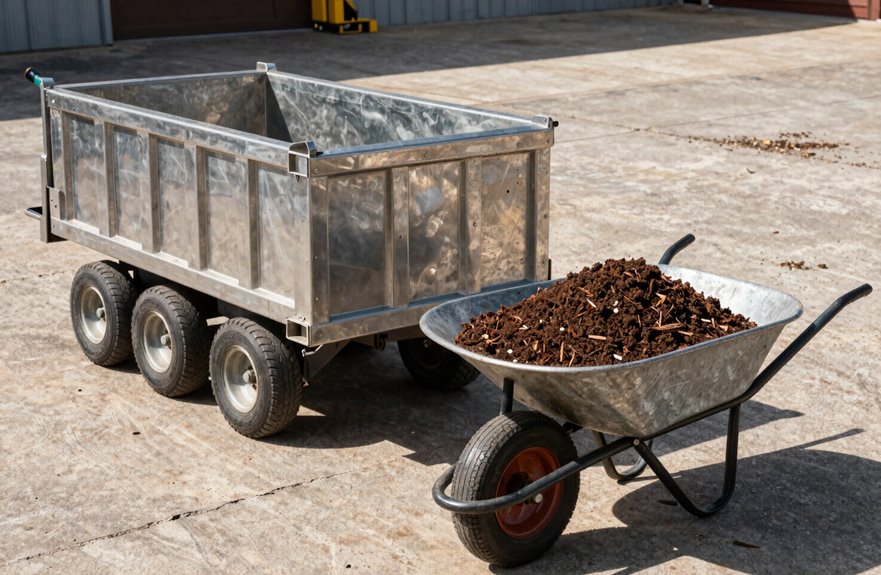
Most weekend projects I’ve tackled meant hauling way more stuff than I thought, and that’s where a dump cart’s real muscle shows up. I’ve watched my wheelbarrow struggle with heavy loads while yard carts just keep swallowing material.
Most wheelbarrows hold 2-3 cubic feet, but a solid dump cart offers 6-12 cubic feet of load capacity. When I’m hauling mulch, that means roughly three to four wheelbarrow trips become one smooth dump cart run. The trips saved add up fast.
The unloading efficiency comes from the dump mechanism, which lets me tilt the whole tray instead of shoveling. Wet soil, compost, rocks, whatever I’m moving, slides right out. Removable sides handle oversized stuff my wheelbarrow couldn’t contain.
Stability Test: Four Wheels vs. One on Slopes and Rough Ground
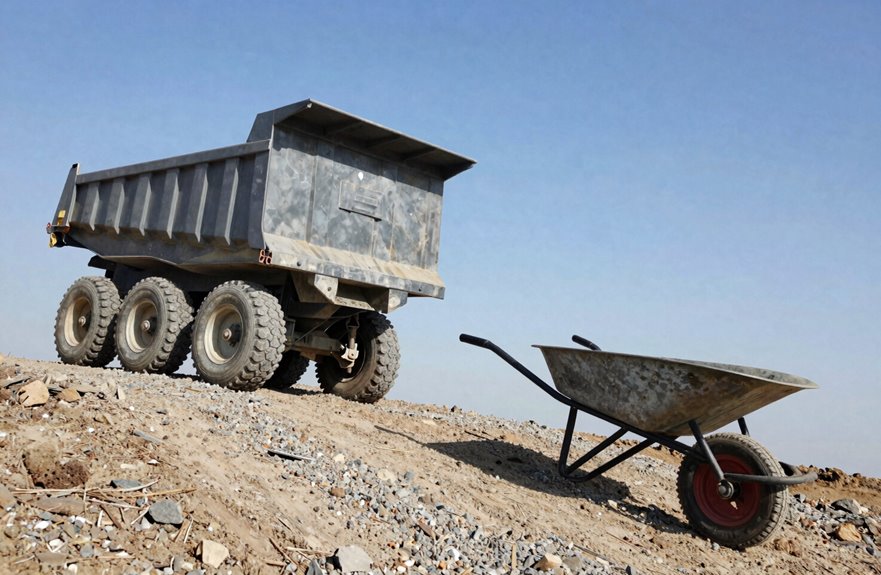
Why does my wheelbarrow always seem to find the one rock that sends everything sideways. We’ve all been there, gripping the handles, praying the load weight doesn’t flip us into the flowerbeds. That one wheel demands constant balancing, especially on slopes where loose gravel turns every step into a gamble.
One wheel, endless balancing acts—every rock a gamble, every slope a prayer against the flowerbeds.
My dump cart with four wheels changed everything. The stability is a tangible improvement. Consider these differences:
- A wheelbarrow teetering on a root, tray tilting, requiring awkward sideways shuffling to compensate
- Four wheels planted firm on rough ground, pneumatic tires absorbing the bumps you can’t see coming
- Actually enjoying the haul instead of white-knuckling through rutted paths
The traction from that wider wheelbase distributes weight evenly, so steep grades become manageable. On broad, uneven sections, four wheels eliminate the balancing act that single-wheel designs require.
Where Wheelbarrows Win: Tight Spaces and Precision Work
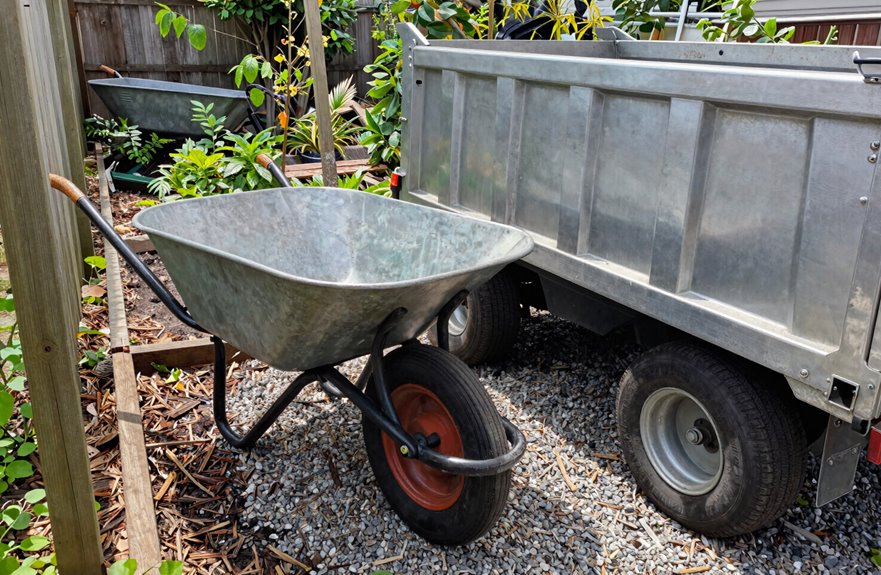
So where does my trusty single-wheeler still earn its keep? Right in the thick of tight spaces and precision work, exactly where bulky carts throw in the towel.
I’ve squeezed my wheelbarrow through 28-inch garden gates, around cramped sheds, and down skinny pathways where two-wheel dump carts would belly-flop. That single-wheel (or nimble two-wheel) design gives me maneuverability no four-wheeler can match. I’m talking pivot-on-a-dime control in narrow layouts and steering around prized hostas without casualties.
When I need targeted placement, say mulching precise beds or spotting gravel exactly where it belongs, my wheelbarrow’s sloped tray delivers unloading accuracy that beats mechanical dumps. Load control feels intuitive; I balance, tilt, and feather materials out precisely. For steep, winding routes and delicate jobs, this remains the best tool for the work.