
You can grab a solid budget wheelbarrow for $79 to $100 if you know where to look. The Marathon Yard Rover at $79 offers 300 lb capacity, a poly tray, and two wheels for stability.
The VEVOR Garden Cart at $83 doubles that capacity to 600 lbs with its steel frame.
Under $50 gets you lighter options like the Pure Garden Folding Wheelbarrow around $47, but expect 300–400 lb limits and shorter lifespans.
Most ship disassembled, so grab a 14mm wrench and set aside 30–45 minutes.
Steel trays handle rocks without cracking, poly saves your back, and dual-wheel designs stop tip-overs on slopes.
Check those details to identify which corners got cut and whether it matters for your yard’s specific needs.
Build Quality and Features You’ll Actually Get Under $100
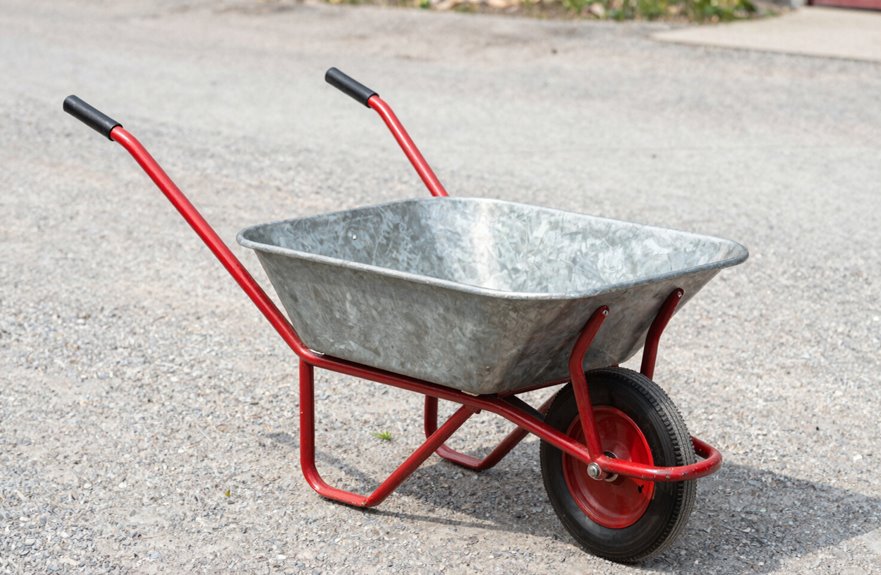
A wheelbarrow under $100 isn’t going to be the tank you’d find on a construction site, but that doesn’t mean you’re stuck with junk. I’ve found budget-friendly wheelbarrow options under $100 still get you solid 4–6 cu ft trays, either steel or heavy-duty poly (that’s plastic, but the tough kind). Two-wheel models like Best Choice Products’ dual-wheel setup give you front stability without breaking the bank. Steel versions usually pack metal handles and trays, which are significantly tougher than flimsy all-plastic builds. Poly bins from Anvil or Original Marathon offer rust-proof, lightweight options, so you’re not wrestling your tool around the yard. The trade-offs are real: lighter frames, smaller wheels, and less stability under serious weight. For weekend use and typical yard work, this performance level is sufficient.
Best All-Around Wheelbarrows Under $100
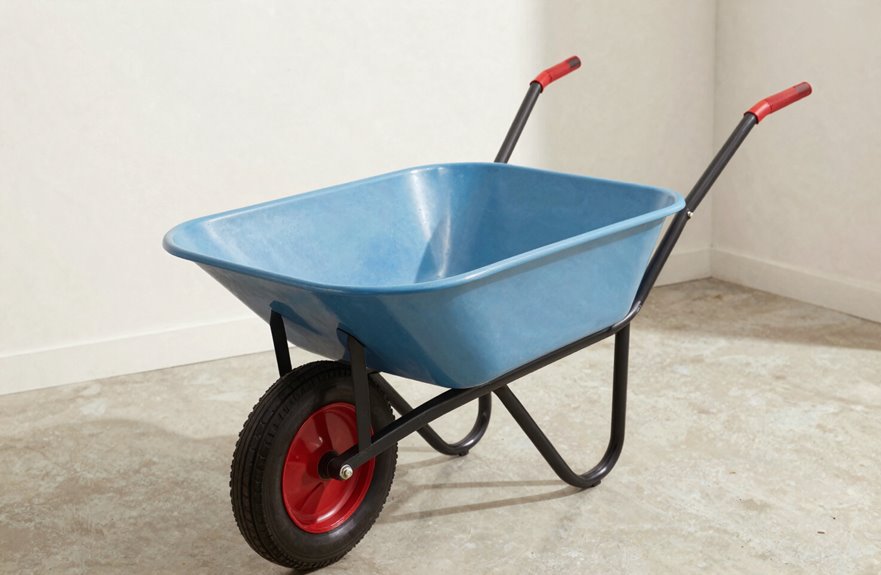
The standouts in the sub-$100 range prove you don’t need to empty your wallet for a workhorse worth owning.
You don’t need to empty your wallet for a workhorse worth owning.
The Marathon Yard Rover Poly Tray 2-Wheel Wheelbarrow costs $79 and offers strong value. It has a 300 lb capacity, perfect for mulch, soil, and other materials. Over 1,695 customers gave it 4.4 stars.
The VEVOR Garden Cart at $82.95 is worth considering if you tackle larger projects. It features a steel frame, poly dump tray, and 600 lb capacity; that’s double the Marathon’s capacity.
The Simpli-Magic Yard Cart reaches 1,100 lbs for $89.99, providing over half-ton capacity. For under ninety dollars, you get serious hauling power for weekend gardening or substantial yard work.
Solid Options Under $50 When Budget Is Tight
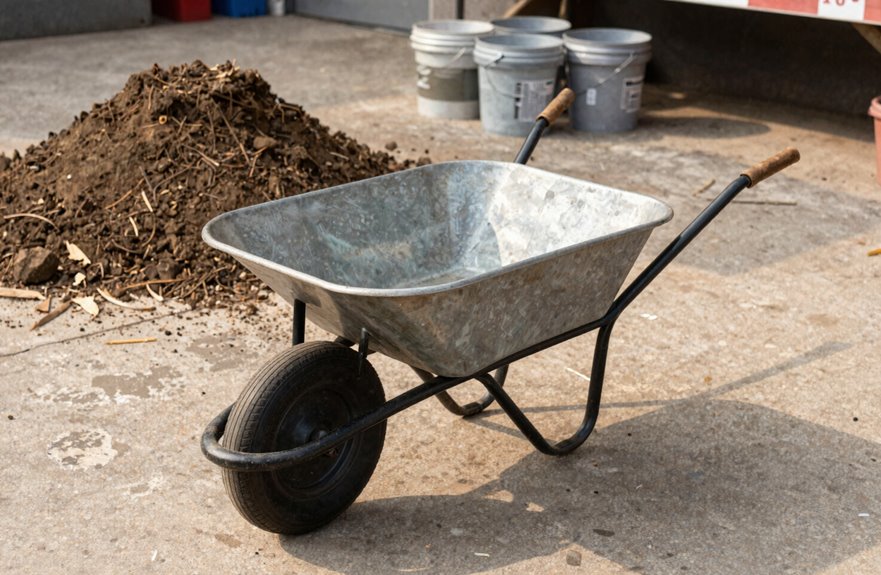
When working with a tight budget, three solid paths are worth exploring: lightweight poly options like the Anvil Poly Bin (that 5-cubic-foot plastic tub with hardwood handles, usually hovering around $46), basic steel frames that give you more rigidity without the premium price tag, or folding cart alternatives that stash away neatly when your shed’s already cramped. These aren’t contractor-grade haulers, but they’ll move mulch, bagged soil, or firewood rounds without breaking your back or your wallet. Under $50 means light-duty capacities, typically 300–400 pounds max, and you’ll trade longevity for affordability. At that price point, expect functional performance for one to two seasons of regular use before replacement becomes necessary.
Lightweight Poly Options
So you’re staring down a yard project with twenty bucks in your pocket and a dream. Lightweight poly options won’t leave you stranded.
The Pure Garden Folding Wheelbarrow hits around $46.95, giving you a collapsible poly tray (that’s the plastic scoop part) that won’t rust when you forget it in the rain, which happens frequently. Small poly tray models run $32–$93, depending on whether you want fancy handles or just basic rolling functionality.
The Anvil-style poly bin delivers roughly 5 cubic feet of hauling space, plenty for mulch runs without breaking your back or budget. These polymer carts resist weather damage and last multiple seasons despite their light weight. For $80–$100, you can grab steel-framed versions that blend a light poly tray with sturdier structural support.
Basic Steel Frames
Why settle for flimsy when you can get real steel for the price of a pizza night? I’ve hauled mulch, concrete, and regret with these budget steel frames, and they punch above their weight class. You’re looking at 150–220 lb capacities (think two bags of cement plus your optimism) in trays around 2–3 feet, compact enough to squeeze through garden gates and beefy enough to feel legit.
What I’ve learned wrangling these sub-$50 workhorses:
- Steel trays dent but don’t crack when you drop them (I’ve tested this extensively, unfortunately)
- Single-wheel designs let you pivot on a dime in tight beds
- Metal handles transfer every bump to your hands; gloves aren’t optional, they’re survival
- You’ll trade dumping smoothness for raw toughness, plus occasional rust patrol
Steel demands respect, not coddling.
Folding Cart Alternatives
Ever hit that wall where $80 feels like a fortune. I’ve been there, staring at my bank account like it personally wronged me. That’s when folding cart alternatives saved my weekend projects.
These compact, foldable lifters run under $50, and they perform well beyond their price point. I’m talking about basic yard tasks: mulch bags, potted plants, maybe a modest rock collection (we’ve all got one). The steel frames fold flat, maybe 8 inches thick, so they slide behind your garage door or hang on a wall hook.
Sure, they won’t haul 300 pounds of wet concrete. The poly trays flex, the wheels wobble on rough terrain, and you’ll replace them sooner than you’d like. For tight budgets and tight spaces, they provide functional utility without significant financial commitment.
Single-Wheel or Dual-Wheel: Which Wheelbarrow Design Fits You?
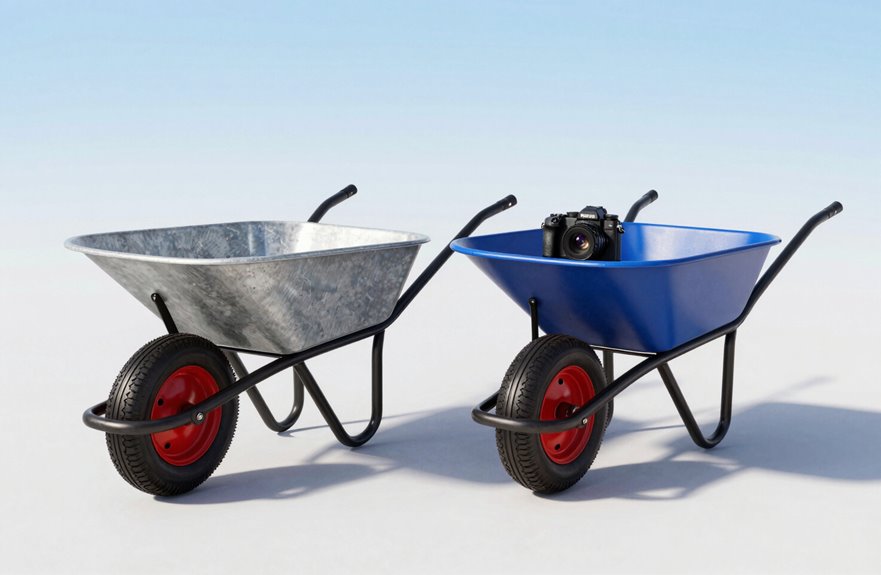
I’m weighing whether you’ll trade a little agility for steadiness, because dual-wheel designs (think the Best Choice Products at roughly $100 on sale) plant a wider 24–28 inch stance that resists tipping when you haul wet mulch or concrete mix uphill. Single-wheel classics, like those 6 cu ft steel models near $100, pivot on a dime in tight garden rows but require you to balance the load like a waiter with a heavy tray. Your terrain and shoulder strength decide this. Flat yards favor the stable twin-tire setup, while the nimble single-wheel works better for weaving between established beds.
Stability Comparison
When you consider choosing between single-wheel and dual-wheel designs, stability isn’t just about how many legs or wheels something stands on. Dual-wheel models, like the VEVOR Garden Cart at $82.95, prove steady under heavy loads on uneven ground. Single-wheel versions tip easier with big hauls, though they’re lighter. Under $100, stability hinges on build quality, such as steel frames and thick poly trays, more than fancy features.
What matters most:
- Dual wheels spread weight wider, preventing dump moments on slopes
- Single wheels require more body English (shifting your weight) to balance, engaging your core
- Four-wheel yard carts trade dumping ease for rock-solid stability during transport
- Wheel width and tire pressure affect stability as much as wheel count. Don’t ignore them
Maneuverability Trade-offs
A single wheel up front means I’m pivoting on a dime, threading through garden gates barely 28 inches wide, but I’m also doing a little dance with my hips every time the load shifts. It’s nimble, sure, but my core works overtime keeping 150 pounds of mulch from dumping sideways.
Dual-wheel designs change the game entirely. With two front wheels (think Best Choice Products or Marathon Yard Rover variants), I’m trading that tight-turn agility for rock-solid stability. No more hip-swaying drama. Just straight-line confidence hauling uneven loads across lumpy yards. Sure, I lose about 6 inches of maneuverability, but I gain stability.
For under $100 (watch for sales dipping to $99–$112), dual-wheel models deliver solid performance without the budget guilt. Stability provides measurable benefits when hauling uneven loads.
Steel vs. Poly Wheelbarrow Trays: Material Trade-Offs at This Price
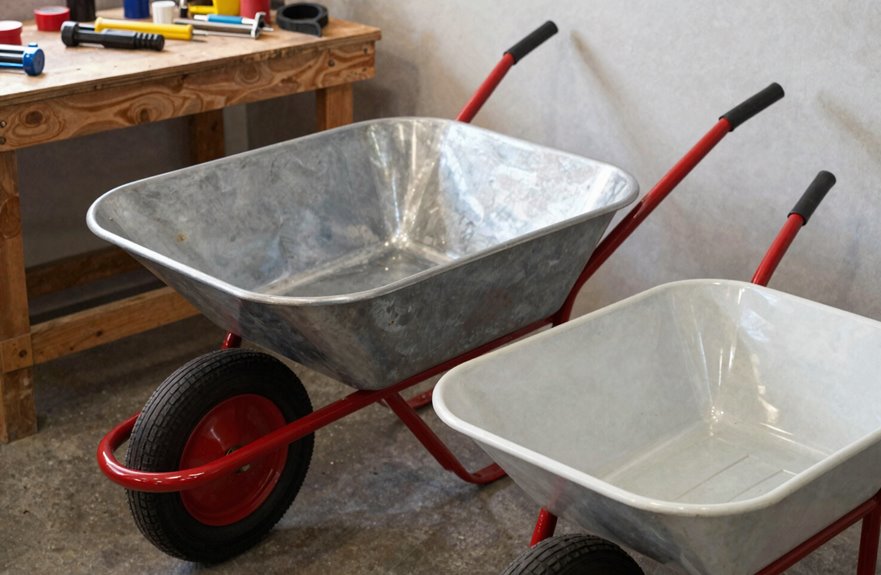
Why does the tray material matter so much when you’re pinching pennies? Steel versus poly isn’t just about looks. It’s about how you’ll actually use this thing weekend after weekend.
- Steel trays (usually 6 cu ft) handle rocks, concrete, and abuse without flinching, though you’ll feel that extra weight when dumping
- Poly bins resist rust completely, so you won’t panic when you forget yours in the rain
- Poly’s lighter frame makes pivoting around tight garden corners genuinely pleasant instead of a wrestling match
- That said, poly models in this bracket sometimes pair plastic tubs with thinner metal frames, so check joint welds carefully
At under $100, both materials work. Pick steel when you’re hauling serious weight. Choose poly when you want something you can lift with one hand after a long day.
Wheelbarrow Wheel Types: Pneumatic, Semi-Pneumatic, or Solid
I want to walk you through the three wheel types you’ll encounter when shopping under $100, because this choice really shapes your hauling experience. Pneumatic tires (think bicycle tires with inner tubes) give you a cushy, shock-absorbing ride over roots and ruts, though you’ll occasionally need a pump and patch kit. Solid wheels skip the flat-risk entirely but jar your arms on rough ground. Semi-pneumatic wheels (basically foam-filled or thick rubber) split the difference; they offer less bounce than air and less rattling than solid.
Pneumatic Tire Benefits
The wheel you choose makes or breaks how your wheelbarrow handles the load, and pneumatic tires (the ones with actual air inside, like a bike tire) give you the smoothest ride this side of a luxury sedan on gravel. I’ve hauled wet concrete across rutted yards, and your back will notice the difference. Pneumatic tires cushion every bump, letting you glide over tree roots and garden beds without spilling your cargo.
What you’re getting with these air-filled tires:
- Superior shock absorption from the inflated tube, saving your arms and load from jarring impacts
- Adjustable air pressure (usually 30–35 PSI) for customizing grip on soft soil or firm paths
- Deeper tread patterns that bite into loose ground when you’re pushing uphill
- Budget-friendly availability on sub-$100 dual-wheel models, though you’ll need a pump and patch kit handy
You’ll occasionally deal with a flat, but pneumatic tires remain the best choice for smooth transport.
Solid Wheel Durability
Flat tires have ruined enough of my Saturday mornings that I’ve learned to respect what solid wheels bring to the party. Made of hard rubber or polyurethane, solid wheels laugh off nails, glass, and thorns that’d leave pneumatic tires dead in the dirt. You trade some cushioning (your back might notice on bumpy ground), but you gain something better: reliability. For weekend warriors like us, that means grabbing the wheelbarrow without checking tire pressure or hunting for a pump. Budget models under $100 often pair solid wheels with steel frames and two-wheel designs, giving you stability without the drama. I’ve pushed these through construction debris and over gravel without a single worry. They’re the set-it-and-forget-it choice for folks who’d rather work than wrench.
Semi-Pneumatic Balance
A semi-pneumatic wheel hits that sweet spot I didn’t know I needed until I tried one. It’s like finding that perfect pair of work boots, tough enough for the job, but my back doesn’t hate me after hauling mulch across lumpy yard.
When I’m shopping under $100, I always check if a wheelbarrow rocks semi-pneumatic wheels because they save me from two headaches: pumping tires every spring and feeling every pebble rattle my teeth.
- They cushion loads on bumpy ground better than solid wheels, so my plants survive the trip
- No flats to patch, which means more weekend, less cursing
- Budget models, think $60-$90 range, pair them with steel trays for steady hauling
- They roll easier than solids when I’m pushing over 100 pounds of compost uphill
For rough yards, semi-pneumatic wheels eliminate maintenance requirements while providing shock absorption that solid wheels cannot match.
How Much Weight Budget Wheelbarrows Actually Handle
Wondering how much weight you can realistically pile into a budget wheelbarrow before things go sideways? I’ve been there, staring at a mountain of mulch, hoping my cheap hauler won’t buckle.
Most budget wheelbarrows under $100 handle between 300 and 600 pounds of capacity. The Original Marathon Yard Rover hits 300 lb (fine for light yard work), while the VEVOR Garden Cart pushes 600 lb for roughly $80–$90. Steel-frame models generally tolerate heavier loads, typically 400–600 lb, compared to poly bins at 300–500 lb. Two-wheel designs add stability but often creep past $100, though some budget options flirt with that price point.
The trade-off is clear: you’re sacrificing some longevity and rock-solid stability for upfront savings. Around $79–$100, you’ll find solid capacity that handles weekend projects without breaking your back or your bank.
What Wheelbarrow Assembly Actually Involves
So you’ve got your budget wheelbarrow unboxed, and now you’re staring at a pile of parts wondering if this’ll take all afternoon. I’ve assembled plenty of these, and budget-friendly wheelbarrow assembly isn’t rocket science.
Most under-$100 models, like that Marathon Yard Rover or VEVOR cart, ship with handles detached, wheels separate, and the tray or tub waiting for connection. You’ll typically need:
- A 14mm wrench and adjustable pliers (or socket set if you’ve got one handy)
- About 30–45 minutes for single-wheel designs, closer to an hour for dual-wheel stability setups
- Thread-locking compound, or at least checking bolt tightness after first use
- A flat surface, because trying to align wheels on grass gets old fast
The steel-frame ones near $100 usually come with clearer instructions than their cheaper cousins. Poly-bin models are lighter to maneuver during assembly, which matters when you’re solo. Don’t overtighten plastic components; they’ll crack.
Weak Points to Check in Budget Wheelbarrows Before Buying
Where exactly should you look when you’re trying to spot trouble before it finds you. Budget wheelbarrows under $100 hide their weaknesses in predictable spots.
First, check the tray material. That $79.00 Marathon Yard Rover and similar models use plastic or poly trays (lightweight, yes, but prone to cracking under impact), so always press firmly along the bottom looking for thin spots. The steel frames matter too; grab them and wiggle. If they flex easily, you’re trading durability for savings you’ll regret.
Wheel attachment points fail most often. Those two-wheel designs (like the Best Choice Products Dual-Wheel) add stability, but their axles bend under the 600 lb loads some carts claim. Test by lifting one wheel slightly; if the frame torques, walk away.
Finally, read reviews mentioning “one season” failures. Models that last multiple years rather than claiming durability without evidence will serve you better.
Maintenance Habits That Extend Your Wheelbarrow’s Life
You can spot all the weak points you want, but a wheelbarrow still won’t last if you treat it like it’ll survive anything. Maintenance isn’t glamorous, but it’s what separates two-season wonders from decade-long workhorses, even on sub-$100 models.
Maintenance isn’t glamorous, but it’s what separates two-season wonders from decade-long workhorses.
Here’s what I do to keep my budget cart rolling:
- Check tire pressure monthly (30–35 PSI for pneumatic tires, or switch to solid polyurethane inserts if you’re tired of flats)
- Rinse the bin after hauling concrete or fertilizer, letting poly trays dry upside down to prevent UV warping
- Grease the wheel bearings twice yearly with a standard grease gun (takes five minutes, saves you $40 in replacements)
- Store it under cover or tarp it, because even “weather-resistant” labels don’t mean “leave me in the rain all winter”
These habits cost almost nothing. They make that $79 Marathon Yard Rover perform reliably for years.
When a $150+ Wheelbarrow Makes More Sense
Sometimes I’ll catch myself loading my $79 Marathon with 500 pounds of wet gravel, and that’s when I know I’ve crossed the line from thrifty to foolish. Budget picks top out around 600 pounds, and pushing that limit warps poly trays, snaps handles, and leaves you buying twice.
Heavy-duty jobs like hauling concrete, moving fieldstone, and daily farm work require steel construction, pneumatic tires with real tread, and welded joints that won’t pop under torque. A $180 Jackson Contractor or $220 True Temper with a 6-cubic-foot steel tray and hardwood handles represents a genuine investment in durability. If you’re tackling serious acreage, professional landscaping, or weekly loads over 400 pounds, spending more upfront prevents mid-project failures and replacement costs later. Your back will appreciate the difference.