

These ideas run from a simple slab with scored lines to a full outdoor kitchen and multi-level pour, with DIY materials staying modest and contractor bids climbing with every trade involved.
What narrows the list is whether you are pouring fresh concrete or working with an existing patio, because stamped patterns and integral color need the wet mix, while resurfacing and decorative inlays can follow later.
The quarter inch per foot slope away from the house is the detail that belongs to every single option, forming stage or not.
1. Stamped Concrete

Stamped concrete presses a pattern into freshly poured concrete to mimic flagstone, slate, or brick at roughly half the material cost.
Stamped stone patterns work best when the stamp and any step forms align on the same pour, a detail that takes planning.
I would check the contractor’s previous work up close before signing; the pattern repeats every few feet, and a careless layout looks like wallpaper.
Sealer goes on regularly to keep the color from fading to flat gray; skip it and the surface dulls faster than you would expect.
For a weekend DIYer, this is not the project; the pour, stamp, and edge work happen in a narrow window before the concrete sets.
2. Colored Concrete
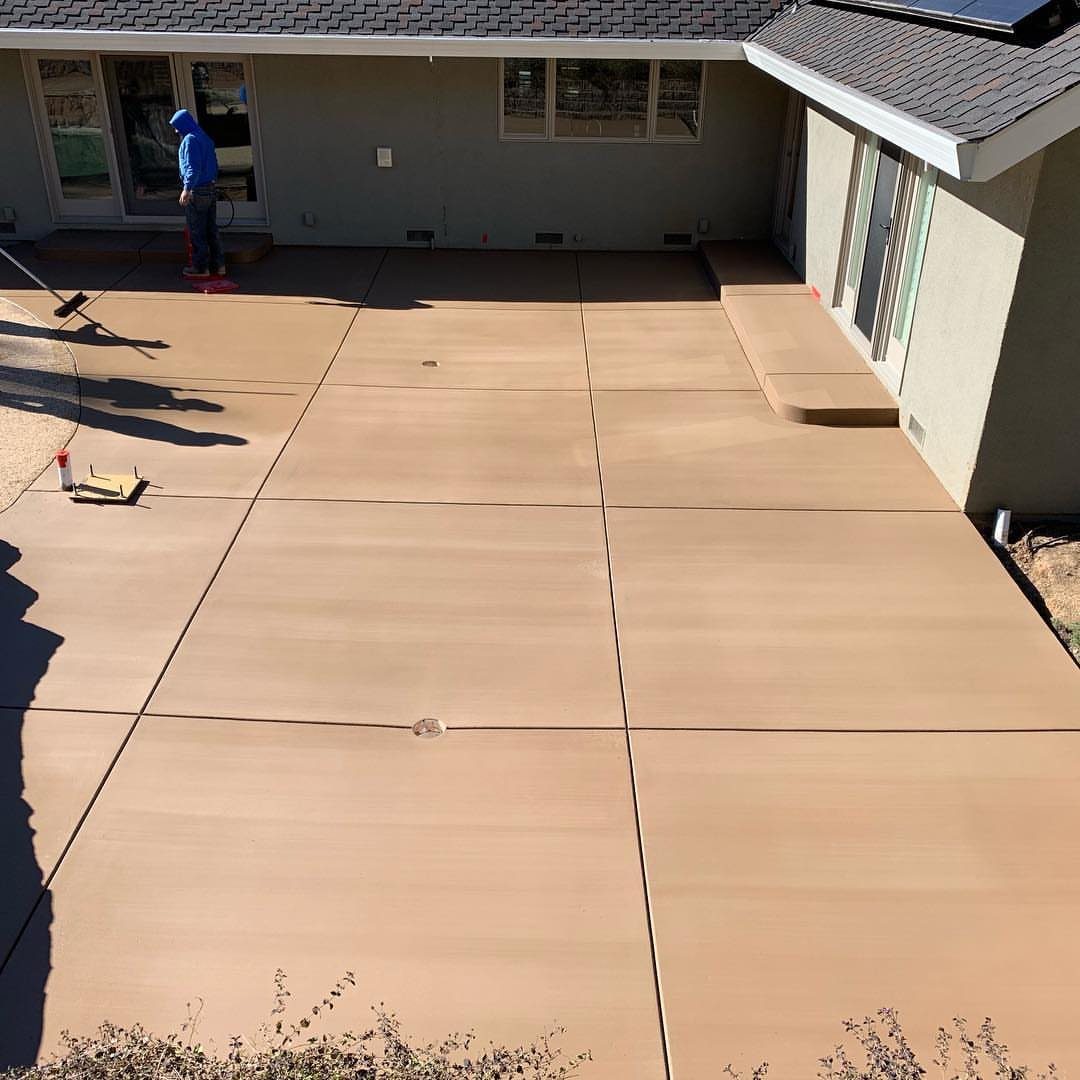
Integral color mixes pigment into the wet concrete so the hue runs through the full depth, not just the surface. Warm tan with scored grid lines breaks the slab into smaller visual squares without actual joints.
I like this approach for a clean, modern look that does not compete with furniture or planting.
The grid scoring happens while the concrete is still green, so the layout gets decided on day one; changing your mind later means a saw cut or a rug.
UV exposure will shift the color over time, so I would order a shade slightly cooler than my target.
3. Fire Pit or Fireplace

A built-in fire feature turns a patio into a three-season room. A gas fire pit with bench seating poured as part of the same concrete structure, plus LED strips under the step nosing, keeps the whole installation unified.
That lighting is low-voltage and easy to add during forming; retrofitting it means cutting into cured concrete.
I would go gas over wood for a built-in this integrated; the smoke staining, ash cleanup, and spark risk do not suit upholstered seating inches away.
The bench back needs a slight backward slope to sit comfortably for any length of time.
A portable fire bowl on an existing slab is the fallback if your budget or timeline does not allow forming and plumbing a fixed unit.
4. Outdoor Kitchen

A full outdoor kitchen under cover runs wood cabinetry and stainless appliances on a concrete slab that carries the load and resists spills.
The slab needs to be poured at the correct height to accept finished flooring or left as the finished floor itself.
I would put the grill and griddle under the roof line but keep any side burner or sink near the edge, where steam and grease vent sideways rather than staining the ceiling.
Running gas, electric, and water to the pavilion is the hidden cost; on a retrofit, trenching across an existing patio can cost more than the cabinets.
A rolling cart with a portable grill stays the practical choice for a tight budget and a single weekend.
5. Covering Structures

A roofed pavilion or gazebo over the patio buys shade in July and dry seating in a light rain.
A metal or translucent roof panel on a wood frame, with string lights for evening use, gives cover without blocking all daylight.
I would check local snow load requirements before sizing the posts and footings; a pergola is lighter and cheaper but leaves you exposed.
The footing for each post typically extends below the frost line, which means cutting into or pouring beyond the existing slab.
On a new pour, I would set the post bases during the slab work; retrofitting means either coring holes or building a floating frame on top.
String lights on a dimmer cost little and do more for ambiance than any furniture upgrade.
6. Patio and Pool

A plunge pool set into the patio slab needs the concrete poured in separate stages: the pool shell first, then the deck with expansion joints where the two meet.
Tile coping and a light-colored deck material read as coordinated but not identical, which hides the joint line.
I would keep the deck surface slightly textured; smooth concrete around water is a slipping hazard, and the pool code in most jurisdictions requires it.
The 2 lounge chairs suggest this is a soak-and-sun space, not a lap pool, so the narrow footprint works.
If your yard is small, a stock tank or shipping container pool on a reinforced slab is the budget workaround, though neither integrates as cleanly as a built-in.
7. Exposed Aggregate

Exposed aggregate pulls the top layer of cement paste away after pouring to reveal the stones beneath, giving a rough, grippy surface that hides dirt and leaf stains better than plain concrete.
Exposed aggregate in warm brown tones suits a traditional brick house, where the texture reads as intentional rather than industrial.
The reveal happens with a surface retarder sprayed on fresh concrete, then washing or brushing the next day; timing varies with temperature, so I would not attempt this on my first pour.
Sealer keeps the stones from popping loose under freeze cycles, and reapplication on a regular schedule is standard in cold climates.
8. Multi-Level Patio

Wide, shallow steps turn a sloped yard into separate rooms: a dining level down low, a planting terrace up high, with the grade change handled by the structure itself.
The pale tile here reads as one continuous surface broken only by the risers, which I like better than abrupt material switches.
Drainage is the detail that decides this. Water running down the upper level needs a hidden channel or a deliberate slope away from the house; trapping it against the foundation turns the project into a repair bill.
I would check the soil bearing too, because a tall retaining wall behind the upper patio may need engineered footings, not just a thickened slab edge.
9. Built-In Seating

A curved concrete bench poured monolithic with a raised planter turns a straight wall into a seating nook that does not shift, rot, or need storage.
Built-in seating wrapping a planting bed works best with a kitchen counter nearby; the bench becomes part of the work triangle if you set a drink ledge at the right height.
The concrete needs a slight crown on the seat, just enough to shed water, or rainwater pools instead of running off. I would add a cushion niche, a routed groove that holds a custom pad in place without ties.
The radius demands flexible forms, so this is not a beginner pour; the curve must be fair or it reads as lumpy, not intentional.
10. Smooth Finish

A steel-troweled surface with control joints in a crisp grid gives the cleanest, most modern concrete look I know, though it trades away every bit of texture.
A light brown smooth slab beside a wood fence keeps the geometry from reading as cold.
The finish is unforgiving. Any footprint, swirl mark, or color variation shows from across the yard, and I would budget for a skilled finisher rather than learning on this surface.
Control joints at regular spacing, cut to the right depth, handle shrinkage cracks; without them, the smooth plane telegraphs every stress fracture. Sealer with a matte sheen, not gloss, keeps the modern intent intact.
11. Decorative Inlays

Terrazzo-style polishing with white divider strips laid in a diamond grid turns a plain slab into patterned flooring that happens to be outdoors.
Dark and tan base tones with light lines creating the geometry read as intentional design rather than afterthought.
The divider strips are brass or plastic set into the wet concrete, then ground flush after curing; polishing follows with progressively finer grits to the sheen you want.
I would keep the pattern large, as here, because small tiles outdoors look busy and collect grime in every joint line.
The gloss level is a safety call: high polish near a pool or step edge is slick when wet, so I would stop at a medium grit in traffic areas and save the mirror finish for covered spaces.
12. Geometric Patios

Large square slabs with narrow gaps between them break a patio into a grid that reads as pavers but pours as concrete, giving the modular look without the sand bed and edge restraint.
Generous scale next to a gray house with a brick chimney needs a yard big enough to carry it; oversized slabs suit open space, not tight corners.
The gaps drain water and allow some movement, but they also grow weeds if left open; I would fill with pea gravel or a polymeric sand that stays flexible.
Pouring each slab separately means more formwork and more cold joints, so the bid runs higher than a single monolithic pour.
For a smaller yard or tighter budget, scored lines in a standard slab fake the geometry at half the labor.
Concrete Maintenance Tips
Sealer matters more than any other maintenance step for a concrete patio, and how often it needs reapplication depends on how much sun hits the surface and how hard you use the space.
I would mark the date of the last application somewhere I will not lose it; waiting until the color has already faded means you are refinishing, not maintaining.
The sealer does 2 jobs: it blocks UV from dulling integral or stamped color, and it creates a barrier against leaf tannins, grill grease, and other stains that sink into porous concrete.
Reapplication is straightforward power-washing followed by rolling on a new coat, but the surface must be fully dry or the film will blush and peel.
I would avoid film-forming sealers in areas with freeze-thaw cycles; they can trap moisture and spall the surface.
A penetrating silane or siloxane sealer soaks in instead of sitting on top, which means less gloss but better long-term protection in cold climates.
Cost-Effective Solutions
Poured concrete for resurfacing costs less on both material and labor than most paver or stone installs, which keeps the budget in check if the base is still sound.
That base cost is why I start with concrete when a budget is tight and the square footage is large.
The real savings come after the pour.
Secondhand metal furniture from resale marketplaces cleans up with degreaser and spray paint for seating at a fraction of retail. I would rather spend there than on the surface itself, since concrete takes finishes and inlays so willingly.
The gaps need filling, pea gravel or polymeric sand both work, but that material cost is minor compared to the edging and bedding a true paver patio requires.
If you’re looking for low-maintenance landscaping ideas, know that poured concrete is usually more affordable per square foot than other patio paving options. According to home services app Thumbtack, concrete resurfacing costs can range from $3 to $10 per square foot.
Design Considerations
Every patio needs slope away from the house, and the figure to remember is a quarter inch per foot as a minimum.
Less than that and water pools; more and furniture feels tilted. Checking for level belongs to the forming stage, before any concrete flows; fixing it after the pour is already set gets expensive fast.
Expansion joints are not optional.
They control where concrete cracks as it shrinks, and their spacing follows the thickness of the slab: roughly 24 to 30 times the slab depth in feet. Skip them and the cracks choose their own path.
For yards with drainage problems, permeable pavers or pervious concrete allows water through the surface rather than shedding it to the property line.
The base is deeper and the material costs more, but it may eliminate the need for a separate stormwater system.
Local codes are worth a look before finalizing the design; some areas give credits for permeable surfaces or mandate them for lots with drainage constraints.
Frequently Asked Questions
Can you paint a concrete patio?
Yes, but proper prep and sealing make the difference between a finish that lasts and one that peels within a season. The surface needs thorough cleaning, any sealer removed, and a bonding primer before paint goes on.
I would use a masonry-specific paint and top it with a clear sealer, since regular exterior paint is not built for foot traffic and UV exposure.
What is the best concrete for a patio?
A high-strength mix, typically 4,000 PSI or higher, holds up under furniture, freeze cycles, and the abrasion of regular use.
Integral color runs through the full depth of the slab instead of sitting on top like a stain, so the hue stays even if the surface wears. That matters more than which brand of mix you choose.
I would also confirm the contractor plans for proper base compaction and the right slab thickness for your soil and load; the concrete itself is only part of what determines how the patio performs.
Will a concrete patio add value to my home?
A well-done decorative patio can increase resale value and buyer appeal, especially when it reads as finished outdoor living space rather than bare slab.
Stamped or colored concrete with clean edges and maintained sealer signals that the yard is usable year-round. The return is highest in climates where outdoor months run long and buyers expect to entertain outside.
How can I update my concrete patio?
Resurfacing, staining, or scoring a pattern into the existing slab are the main routes, each with a different cost and commitment.
Resurfacing with a thin overlay covers cracks and discoloration; staining adds color but needs the surface to be absorbent, not sealed.
Scoring lines in a grid fakes the look of large pavers without hauling off the old slab. If the concrete is sound and you just want a visual refresh, a rug and planters do most of the work.