Your fireplace’s gas use hinges on five things: the unit’s BTU output (30,000 in many cases), whether you’re burning natural gas (~$0.30/hour) or propane, your efficiency rating (AFUE percentages significantly impact consumption), how hot you actually run it (a 75°F setting burns more fuel than 68°F), and your room size plus climate (drafty rooms in winter consume more fuel).
Adjusting any of these factors will noticeably affect your monthly bill.
Gas Fireplace Consumption: Typical Costs Per Hour and Month
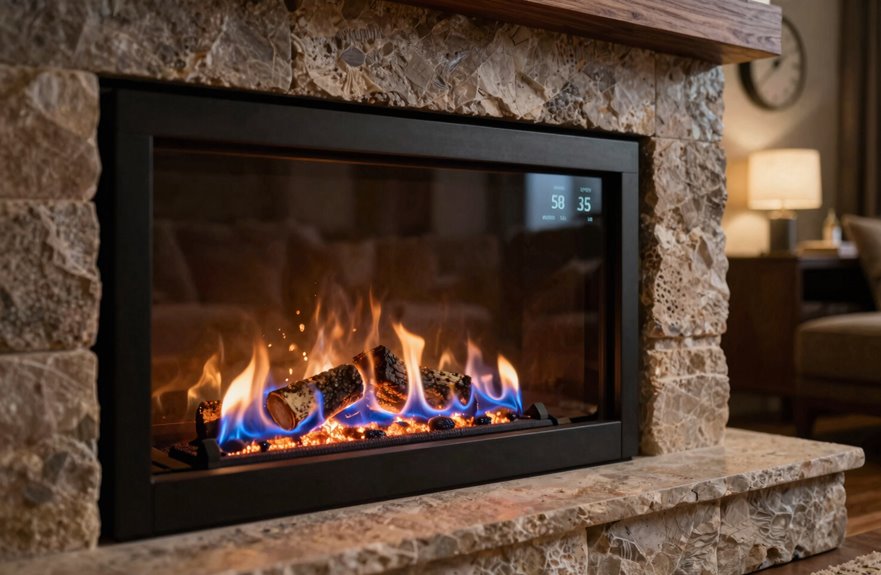
So, how much is that cozy flame really costing you? The numbers show that most units run 20,000–60,000 BTU output, which translates to roughly 0.3 therms of natural gas per hour for a mid-sized model (think 30,000 BTUs at 70% efficiency). At about $1 per therm, that’s roughly $0.30 cost per hour, a reasonable expense for that warm glow.
Your hourly fuel use depends heavily on flame intensity (crank it high, pay more), unit efficiency, and whether you’re burning natural gas or propane. Zone heating, firing up just the living room instead of the whole house, cuts monthly bills dramatically. Smart controls and regular maintenance keep your fireplace running lean.
Natural Gas vs. Propane: Which Fuel Costs Less to Burn?
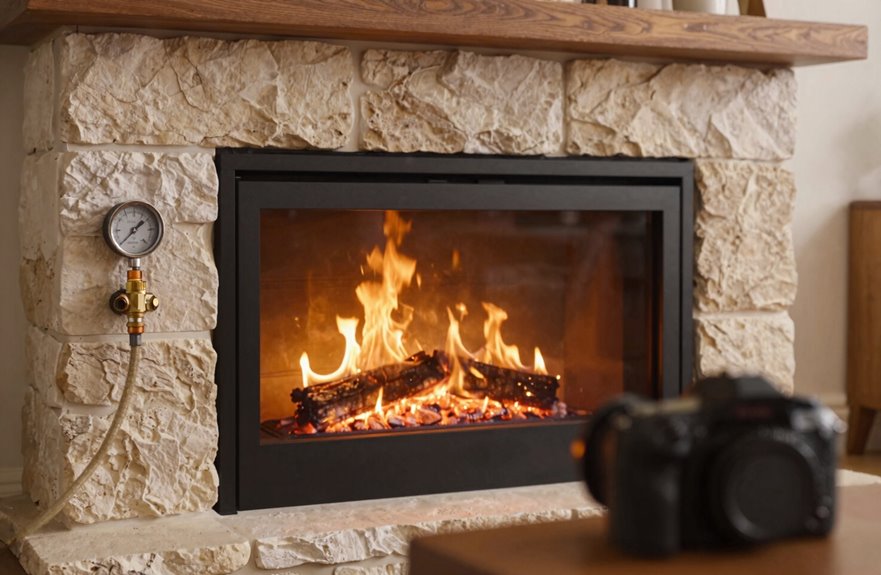
The fuel you feed your fireplace affects your heating costs significantly. After comparing my neighbor’s propane bill to my natural gas statement, here’s what the numbers show.
Natural gas gets priced by the therm (100,000 BTU), while propane runs by the gallon, about 91,500 BTU per gallon, or roughly 0.9 therms. My area charges around $1.20 per therm for natural gas versus $3.00 per gallon for propane. Running a 30,000 BTU unit requires 0.3 therms hourly for natural gas, but 0.33 gallons per hour for propane.
The math shows propane costs more per BTU. For identical heat output, natural gas typically costs less to operate. Efficiency matters as well; direct-vent models use less fuel than open-vent models, regardless of which fuel type you choose.
How Efficiency Ratings Reduce Your Actual Fuel Usage
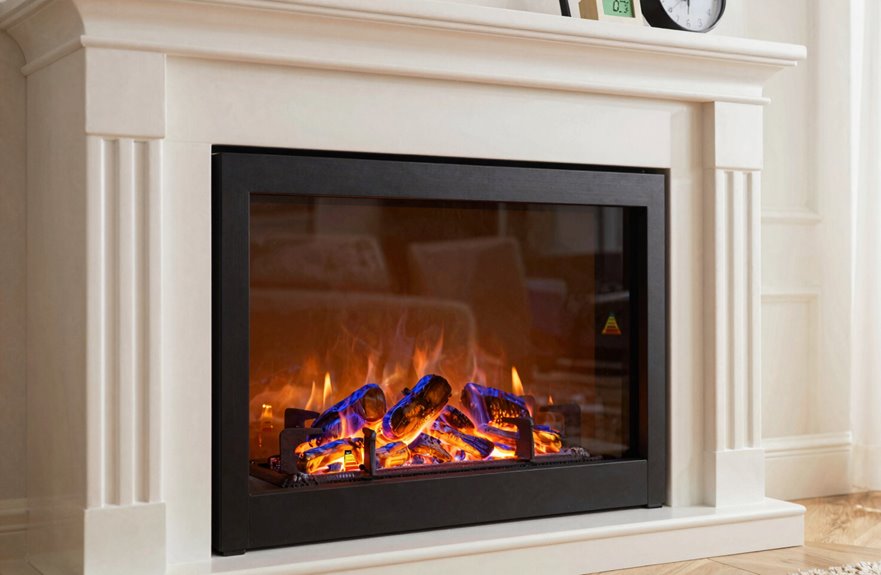
Why does your neighbor’s fireplace guzzle gas while yours sips it? Efficiency ratings hold the answer. AFUE (Annual Fuel Utilization Efficiency) tells you how much of your fuel’s BTU content actually warms your room versus vanishing up the chimney. Higher ratings mean lower fuel usage, plain and simple.
| Efficiency Rating | What It Means for You |
|---|---|
| 60–70% AFUE | Older units, higher gas consumption, noticeable exhaust losses |
| 80–85% AFUE | Mid-range performance, decent heat delivery, moderate savings |
| 90%+ AFUE | Direct-vent systems, minimal waste, maximum coziness |
| Post-installation | Annual maintenance sustains peak efficiency, protects your investment |
Direct-vent designs slash exhaust losses dramatically. Installation quality matters as much as the unit itself. Poor venting sabotages even top-tier models. Annual maintenance preserves efficient performance throughout the heating season.
Why Your Thermostat Settings and Daily Habits Matter Most
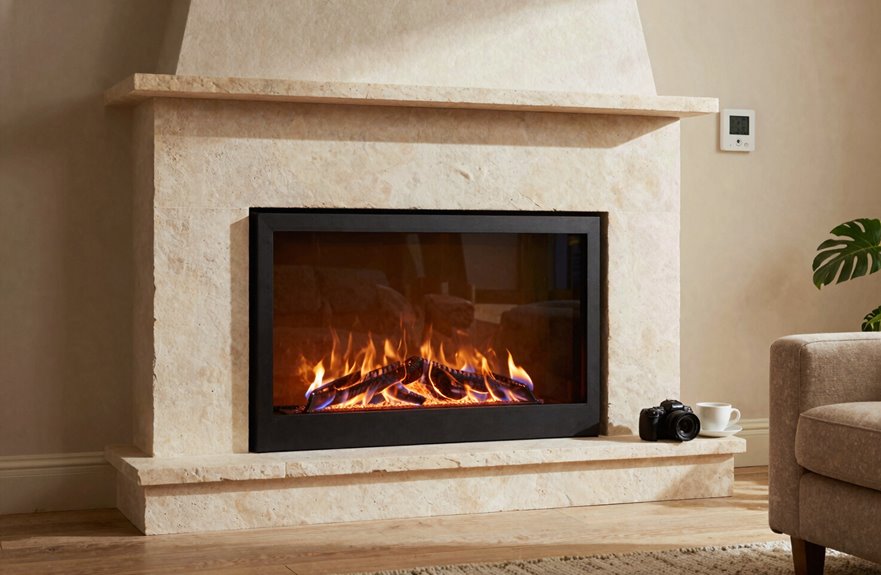
How much gas did I burn through last winter without even noticing? My thermostat settings and daily habits were the real culprits behind my shocking bills.
Cranking up the heat raises your propane burn rate and natural gas consumption significantly, since your fireplace works overtime hitting 75°F instead of a sensible 68°F. My daily habits, like leaving flames dancing while I ran errands, spiked my gas usage without me there to enjoy them.
Now I use programmable controls and timers to match occupancy-based heating, running the fire only when I’m actually home. Zone heating lets me warm just my living room, not the whole house. I keep flame intensity moderate too. Still toasty, and noticeably lower bills.
Room Size, Climate, and When to Expect Higher Bills
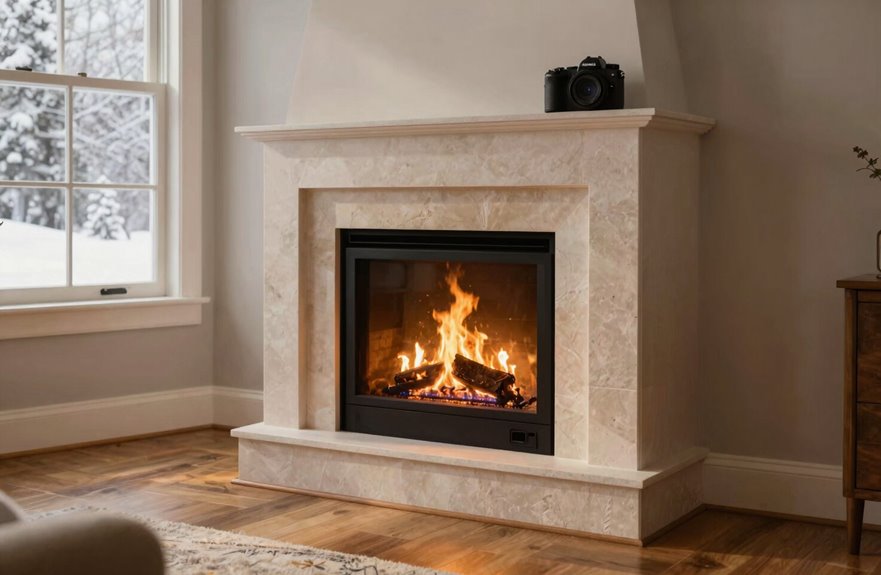
Beyond my thermostat habits, I quickly learned my living room’s sheer size was working against me. Room size directly dictates your fireplace’s BTU (British Thermal Units, essentially heat output) requirements, and I discovered my 700-square-foot space needed 20,000–30,000 BTU, not the undersized unit I’d installed. Colder climate absolutely spikes heating demand, so I’ve marked my calendar for seasonal timing. November through March, my gas usage doubles.
Poor insulation reduces efficiency significantly. I’ve since sealed windows (caulk gun, $6) and added weatherstripping, because heat loss kills efficiency. Venting matters enormously; direct vent systems retain heat while unsealed chimneys lose it rapidly. Match fireplace size to actual space needs, or you’ll waste money on heating costs that could have been avoided.