I’ve hauled enough mulch to know wheelbarrows and carts aren’t interchangeable. Wheelbarrows carry about 6 cubic feet, tip easily for dumping, and squeeze through narrow gates. They work well for hills and tight corners.
Carts hold 6 to 12 cubic feet, ride stable on two wheels or four, and handle 300-pound loads on flat ground without excessive strain. You’ll lift and pitch a wheelbarrow to empty it; carts offer mechanical dump assistance.
Rough terrain matters here: metal wheelbarrows survive rocks, while plastic carts crack. Maintenance differs too. Wood needs yearly sealing, and steel requires rust prevention.
Your yard’s layout, not loyalty, should determine your tool choice. The right hauler depends on matching your specific terrain and load requirements.
Wheelbarrow or Garden Cart: Which Matches Your Yard?
When choosing between a garden cart and a wheelbarrow for yard work, consider which tool actually delivers results without strain or frustration.
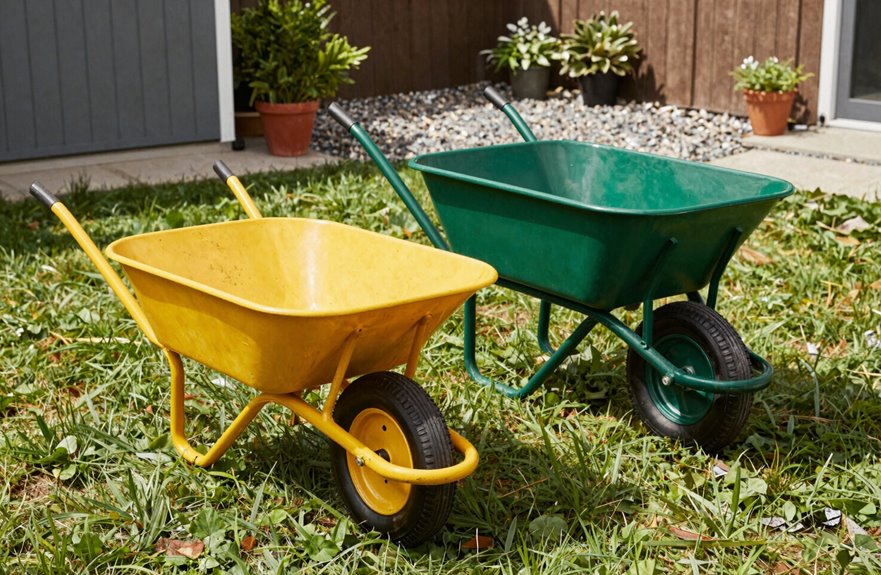
A garden cart offers a wide, flat bottom and serious load capacity, ranging from 6 to 12 cubic feet. It provides stability on rough ground and handles bulky materials effectively. A wheelbarrow features a deeper tub but requires trickier balance, particularly single-wheel models. Its narrower design allows access to tighter spaces where carts cannot fit.
For bulky, heavy loads on open ground, a cart performs best. For precision work and maneuvering through narrow passages, a wheelbarrow is the better choice.
Hills, Paths, or Open Beds: Where Each Tool Wins
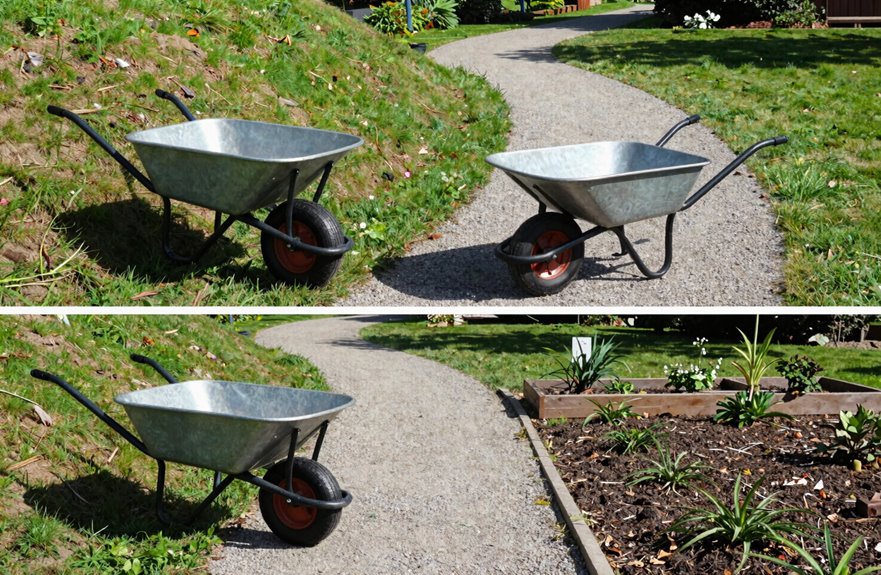
On steep slopes or winding paths, I reach for my wheelbarrow. Its single-wheel design provides the maneuverability needed to pivot around corners, navigate between raised beds (typically 18–24 inches wide), and lift over steps between garden levels. The lighter footprint means working with terrain rather than fighting it.
When crossing open ground, such as flat lawns or wide vegetable rows, a garden cart performs better. Those larger, stable wheels and flat bottom keep loads level without tipping, though the wider wheelbase (often 30+ inches) makes tight turns difficult.
Rough, rocky patches require metal wheelbarrows for durability. Plastic carts chip and crack more easily. Matching your tool to the ground conditions determines which one will serve you best.
How Much Can a Wheelbarrow or Cart Actually Carry?
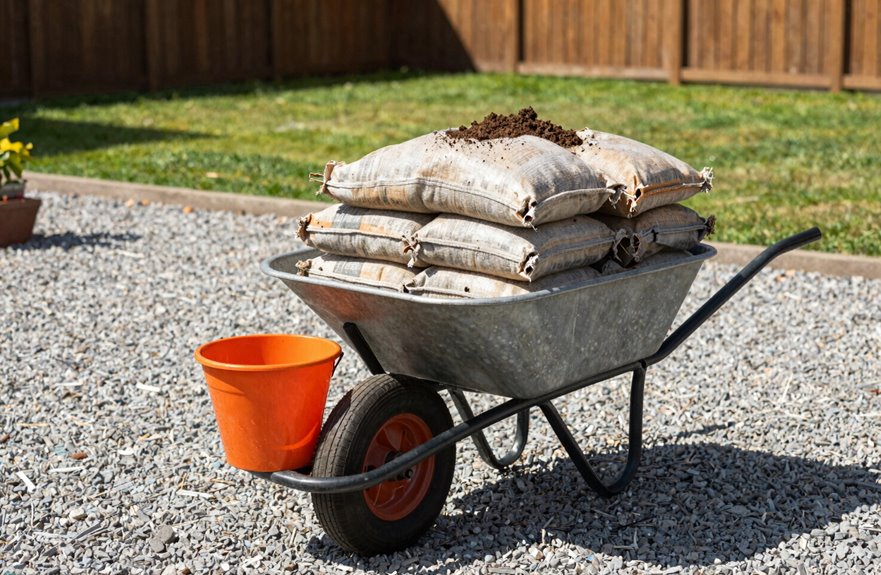
I want to start by nailing down standard capacity ranges. Most wheelbarrows hold about 6 cubic feet, while garden carts stretch from 6 up to 12 cubic feet depending on the model. You can haul twice the mulch in one trip if you pick the right cart. Load weight factors matter just as much as volume though. Wheelbarrows with their single-wheel or dual-wheel balance points can feel tipsy when you’re dropping in heavy flagstones, whereas carts spread that weight across an axle like a little red wagon that won’t dump your tools mid-yard. Once you grasp volume conversion basics, knowing that roughly nine wheelbarrow loads make a cubic yard, you’ll stop overordering gravel or making four extra trips when two would have handled it.
Standard Capacity Ranges
Just how much can you actually haul before your arms give out or your patience runs thin? Consider a practical scenario: staring at mulch piles and deciding between nine trips or three.
| Feature | Wheelbarrow | Garden Cart |
|---|---|---|
| Typical capacity | ~6 cubic feet | 6–12 cubic feet |
| Two-wheeled vs single-wheel | Single-wheel (tippy) | Two-wheeled (stable) |
| Bulk material handling | Okay for light loads | Better for heavy, bulky stuff |
| Trip efficiency | More trips needed | Fewer trips, less grunt work |
| Storage reality | Fixed size | Some fold down (space savers) |
The single-wheel design limits your practical capacity on uneven ground because the weight concentrates on one point. Dual wheels distribute weight evenly, allowing you to use that full 12 cubic feet on smooth paths. For big projects, those extra cubic feet reduce the number of trips needed to complete the work before sunset.
Load Weight Factors
How much can you actually haul before your arms stage a mutiny or your lower back files a formal complaint? Load weight depends heavily on load distribution, not just raw capacity. Wheelbarrows concentrate everything on your arms and that single wheel, which is brutal on soft ground, while carts spread weight across two axles for significantly better performance with heavy stone or wet compost. A wheelbarrow’s 6-cubic-foot capacity sounds decent, but load it with damp sand and you’re wrestling 500+ pounds. Carts handle 6–12 cubic feet with better stability, so you can push your load weight higher without the wobble. Front-dump carts especially perform well here, unloading efficiently so you aren’t stuck half-carrying stuck material. Match capacity to your terrain and material. Overloading either tool turns yard work into an injury waiting to happen.
Volume Conversion Basics
While load weight tells you what your body can handle, volume tells you how many trips you’ll actually make, and the math varies by equipment. A standard wheelbarrow holds about 6 cubic feet, while garden carts typically stretch from 6 to 12 cubic feet (or more, if you’re hauling with those beefy front-end dump carts). One cubic yard equals roughly nine wheelbarrow loads, assuming you’re moving about 3 cubic feet per trip. Smaller folding carts hit that same 6 cubic feet mark, but larger carts let you stack heavier, bulkier items without the balancing act. For lighter, loose stuff, a wheelbarrow offers precise dumping. Never overload; control beats capacity every single time.
Steering, Tipping, and Dumping: Handling Compared
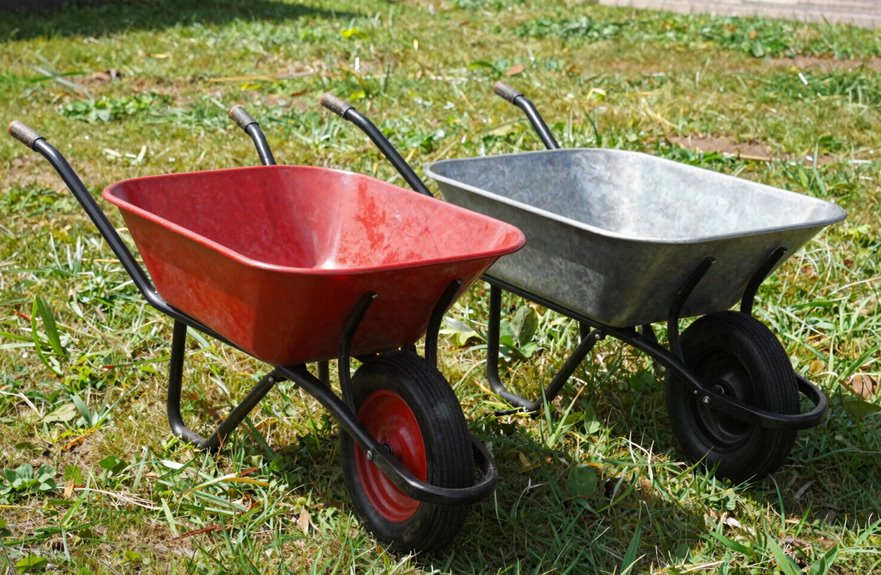
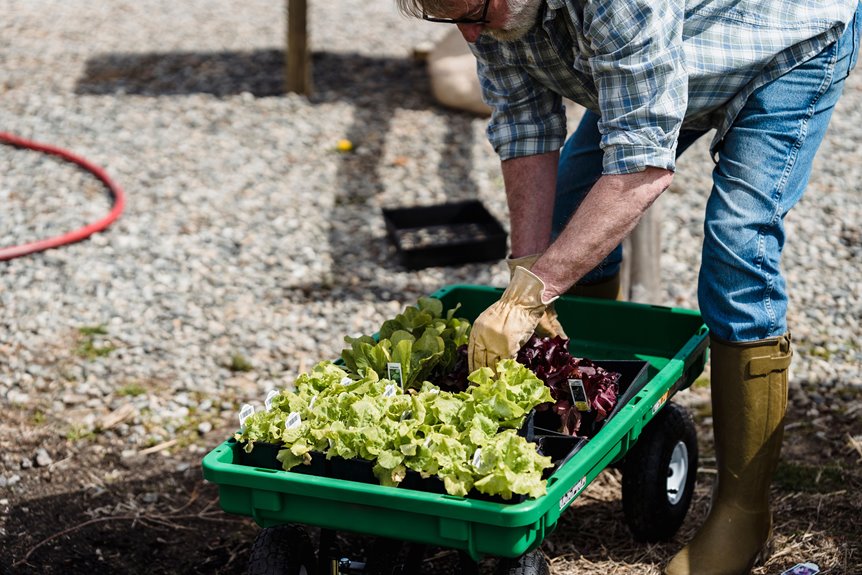
Wheelbarrows demand you lift and pitch, which works fine until you’re 50 and your rotator cuff starts failing. Dumping with a cart changes everything. Many have front-end or tail-end mechanisms (pull a lever, bed tilts, you’re done), while a wheelbarrow needs brute force. Stability matters too. Carts sit flat with multiple wheels, so uneven ground won’t send your mulch flying. Steering requires more space, but two or four wheels mean no balancing act.
On smooth surfaces, I push 300 pounds in my cart without breaking form. Tight corners favor wheelbarrows. For handling heavy loads solo, dumping without lifting, and avoiding that sideways tip, carts keep me gardening longer with fewer complaints.
What Survives Seasons of Mud and Neglect?
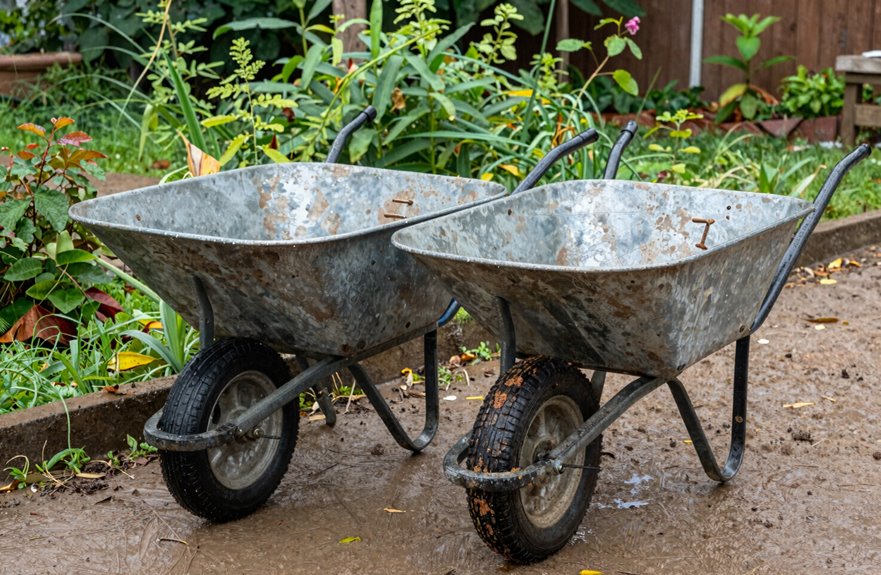
I’ve learned the hard way that not all yard haulers age gracefully when left to the elements. When you’re comparing material durability factors, weather resistance, and maintenance requirements, you’ll find some surprising winners and losers in the mud-and-neglect olympics. Let’s break down which construction choices actually hold up when the seasons turn harsh and your storage system is basically forgotten until spring.
Material Durability Factors
Because I’ve left both tools caked in mud until spring more times than I’ll admit, I’ve learned the hard way that material choices determine whether you’re hauling dirt or hauling your cart to the curb.
Metal trays and HDPE tubs (that’s high-density polyethylene, the tough plastic stuff) deliver real durability against punctures and wear, while wooden beauties like Vermont Carts demand staining and finishing to fight rot. I’ve watched corrosion eat through unprotected steel frames, so rust-preventive coatings matter. Solid rubber tires skip flats entirely, though they bounce you around more in mud than pneumatics. Front-end dumping mechanisms on heavier carts handle repeated abuse, but thin plywood warps, rots, and fails. Maintenance keeps you in the club: tire checks, rust prevention, and proper drying. Wall racks work wonders for metal variants.
Weather Resistance Comparison
Few garden tools face the brutal honesty of four seasons quite like these two haulers, and I’ve buried enough rusted frames in the shed to know which designs actually laugh off a little or a lot of neglect.
Let’s talk weather resistance first. Those pneumatic tires, air-filled like your bike, cushion muddy ruts beautifully. One hidden thorn means you’re stranded mid-haul. Solid tires never flat, though you’ll feel every rock.
Now, materials matter when comparing metal versus plastic. My steel cart survived three winters with a rust-prevention coating, but skip that step and you’ll get orange dust. Plastic-tub wheelbarrows rinse clean after spring mud, though I’ve watched cheaper ones go brittle after seasons of freeze-thaw cycles. HDPE-tub carts cost more upfront, but they won’t crack when left in February temperatures.
Maintenance Requirements Vary
Wooden parts (handles, plywood beds) demand staining or sealing yearly, or they’ll rot from mud exposure faster than you can say “termite buffet.”
Solid tires skip flats but wear unevenly on ruts. Pneumatic tires need pressure checks, but ride smoother on your wrists.
Dump hinges collect grit, so hose and grease them monthly. Neglect cracks the mechanism.
Rust-prevention means wall storage (get it off damp concrete) and touching up steel trays with enamel when chips appear.
Maintenance directly determines how long equipment lasts.
Choosing Between Wheelbarrow and Cart: Your Decision Framework
So you’re staring at your yard, maybe with a pile of mulch or a stack of flagstones waiting, and you’re wondering which beast of burden actually deserves your money.
Weight distribution changes everything. Single-wheel wheelbarrows demand you balance that load, like tightrope walking with dirt, while carts spread weight across an axle. This makes them stable, steady, and forgiving. Wheelbarrows win on narrow paths and slopes. I can pivot mine through gate openings that would trap a cart. Load capacity tells another story. Most wheelbarrows top out around 6 cubic feet, while garden carts hold 6–12 cubic feet without breaking a sweat.
Choose the wheelbarrow for agility and hills. Grab the cart for bulk jobs on flat ground. Your muscles will appreciate the difference.