
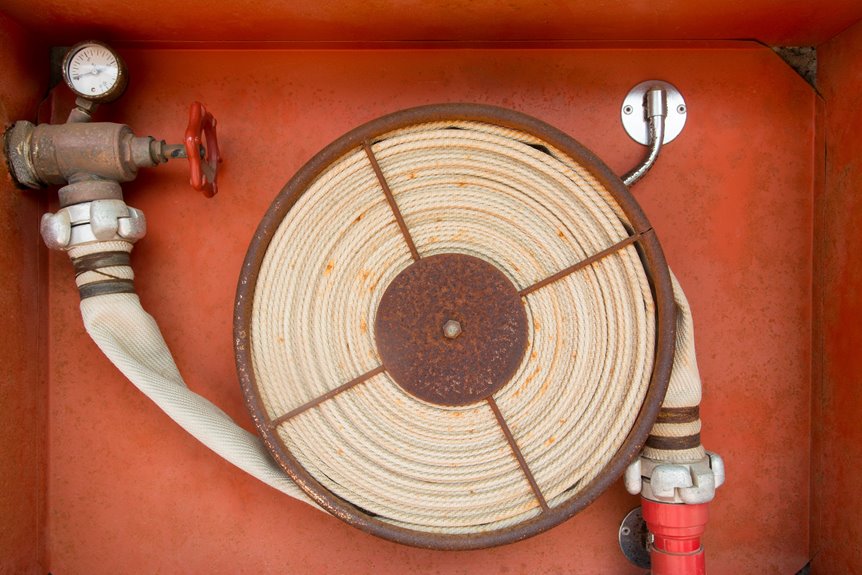
A flat steel spring winds tighter around the drum axle when you pull the hose out, similar to winding a clock. A ratchet-latch, usually with a pawl engaging notched teeth, locks your desired length, say exactly 17 feet, with a satisfying click. Tug the latch gently, and that stored spring energy spins the drum for quick, controlled retraction. Guide rollers, typically two-inch nylon or steel, keep the hose tracking straight and prevent tangling. A swivel joint at the base lets water flow continuously even as the drum rotates 360 degrees. The whole system depends on proper alignment; correct spacing between wraps preserves your hose’s bend radius and prevents early wear. Mounting choices and maintenance practices are critical factors that determine how long these devices remain functional.
How Hose Reels Store and Release Hose
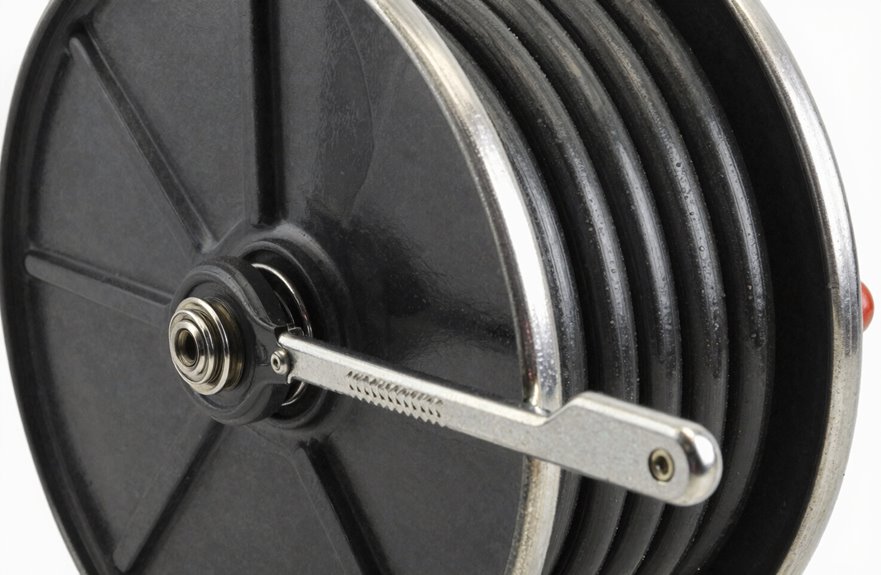
How exactly does a simple drum manage to tame fifty feet of unruly 5/8-inch garden hose without turning your garage into a green spaghetti nightmare? I’ve wrestled with enough hoses to know the magic happens in three phases: extension, locking, and retraction.
When I pull the hose out, I’m actually winding a flat steel spring tighter around the axle, like winding a clock. That ratchet-latch I hear clicking holds everything at exactly 17 feet if that’s where I need it. The guide arm keeps things aligned so the hose layers evenly.
When I give that latch a gentle tug, the stored spring energy spins the drum, sucking that hose back in faster than my kids devour pizza. There are no tangles, just mechanical function.
How the Drum Cylinder Prevents Kinks and Tangles
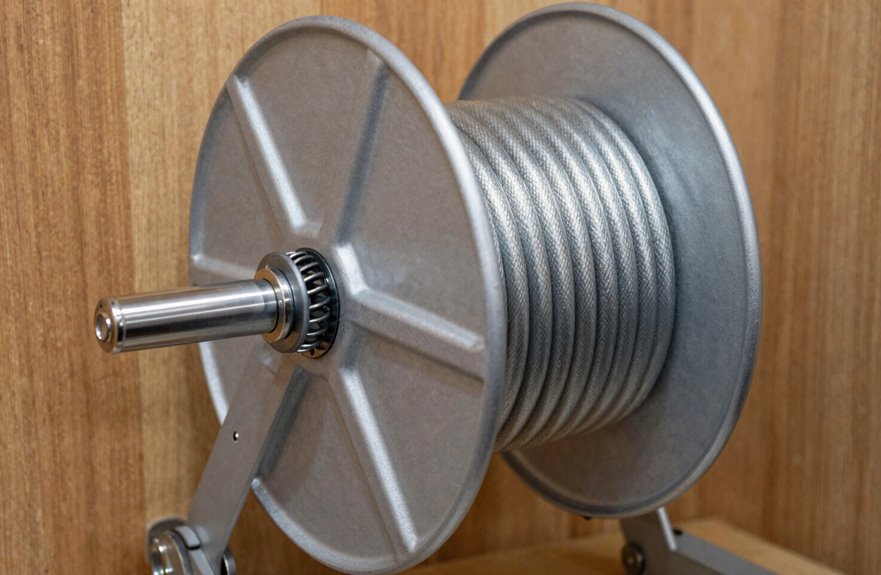
The drum cylinder serves as a critical component, with its smooth rotation design (usually mounted on a ½-inch steel spindle with sealed ball bearings) keeping everything moving smoothly rather than in a jerky manner that creates resistance during operation. The even winding pattern is equally important; those guide rollers and split-roller assemblies function as directional controls for your hose, layering the tubing in neat, side-by-side rows instead of allowing it to pile up irregularly. Controlled hose tension, maintained by a spring-loaded retraction mechanism (typically 15–30 foot-pounds of torque on residential models, up to 50 for commercial), applies just enough pull to keep the hose flat without stretching it or allowing it to become loose.
Smooth Rotation Design
Because a tangled hose tests your patience, this smooth rotation design keeps everything flowing without complications.
The drum spins on precisely machined rollers and guides (think of them as tiny, tireless traffic cops), ensuring your hose glides rather than grinds. When you crank that handle, several mechanisms work together:
- The swivel joint rotates freely, so your hose never twists itself into a pretzel
- Guides channel the hose along a gentle, curved path without sharp 90-degree angles
- Rollers distribute tension evenly, so retraction feels buttery smooth, not jerky
The winding path around the drum is calculated to eliminate kink-causing bends. Your hose’s inner lining stays intact, and the design prevents the frustration of fighting a rebellious garden snake.
Even Winding Pattern
Smooth rotation gets your hose rolling, but you’ve likely fought that dreaded bird’s nest at the end of the season. The even winding pattern prevents this problem.
The drum cylinder wraps your hose onto a central spindle (think of it like a paper towel core, but beefier), keeping each loop aligned so nothing crosses over. A winding guide, usually a roller or eyelet, steers the hose along a uniform path during retraction, which stops sharp bends from forming at the drum’s edge.
The spring-driven mechanism maintains steady pull, so your hose spirals smoothly, layer by layer. No overlaps, no knots. The guide arms angle everything just right, and that slow, consistent wrap preserves your hose’s integrity. You get neat storage and won’t dread next spring.
Controlled Hose Tension
Why does your garden hose always seem to fight back when you’re reeling it in? Wrestling with kinks that feel personal is a common frustration. The drum cylinder changes everything by managing tension so your hose cooperates instead of conspiring against you.
Here’s what happens inside that reel:
- The drum pulls your hose straight, eliminating those angry loops that turn into knots
- A guide arm tracks each layer perfectly, keeping everything aligned
- Retraction happens smoothly without sudden yanks that twist everything sideways
When you extend the hose, controlled tension lets it glide without bunching. The swivel joint at the base spins freely, so water flows while the drum rotates. Your hose will no longer tangle or resist during use.
How Ratchets and Latches Lock Hose Length
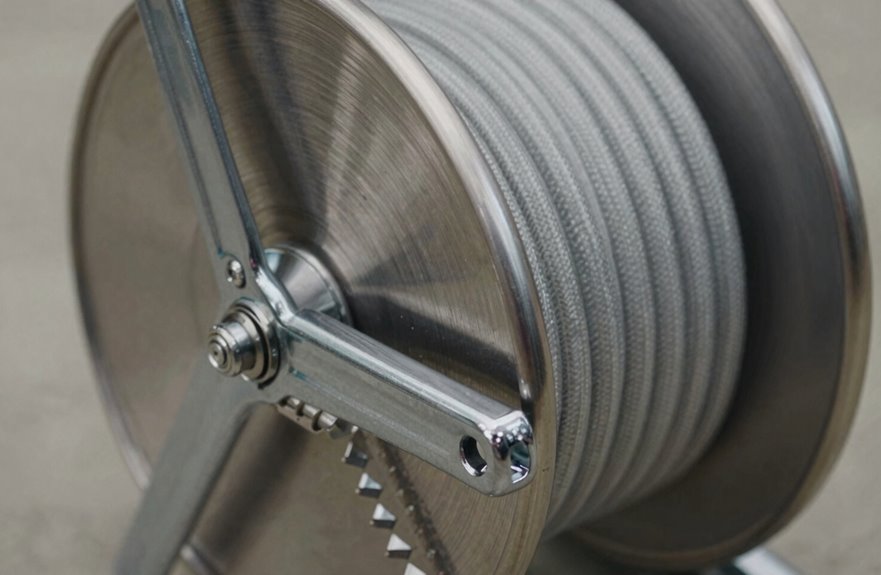
I’ve pulled out exactly four feet of hose and there’s that satisfying click (you know the one, it sounds like a socket wrench catching its tooth), which means the ratchet wheel just locked against the pawl. The mechanism works like a backwards bicycle cog: pull freely outward if you want more length, but try to let go and the angled teeth jam against the latch to hold your position. A steel pawl, which is basically a spring-loaded finger, drops into each notch as the drum rotates, and it’ll keep catching at every quarter-turn until you’ve got all thirty feet deployed or you’re happy with the reach.
Ratchet Mechanism Function
Ever wonder how a hose reel knows exactly when to stop unspooling without snapping back like an angry rubber snake. The ratchet mechanism works quietly behind the scenes so you don’t wrestle your hose like it’s got a mind of its own.
Here’s what happens when you pull:
- The toothed wheel (that’s your ratchet) spins with each tug, teeth clicking past the pawl like a friendly gear greeting
- The latch drops into place between teeth, locking your exact length with no slip and no surprise rewind
- You’re free to water, wash, or spray without the reel fighting back
Hose reel mechanisms like this use that pawl-and-ratchet dance to give you control. Some setups offer multiple latch positions for precise lengths, others keep constant tension. Either way, you remain in charge until you decide to release.
Latch Engagement Process
When you tug that hose outward, the ratchet wheel spins forward. My spring-loaded pawl, a tiny metal finger, snaps into the next engagement notch with a satisfying click. That latch locks us in, maintaining perfect tension while watering tomatoes or washing the truck. The pawl-and-notch arrangement allows the hose to extend freely but resists any backward slip. When you’re done, flip the release, the latch disengages from the ratchet, and the pre-tensioned spring retracts everything. Alignment is critical; poor interlock causes slippage, and a hose reel requires secure length commitment.
How Swivel Joints Keep Water Flowing During Rewind
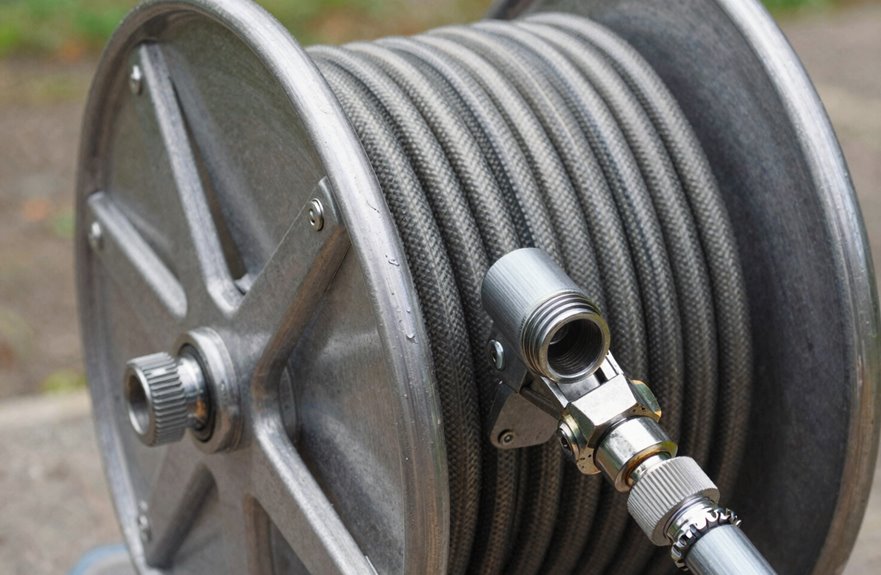
When you rewind a hose while the water’s still running, a small mechanical component makes that possible.
The swivel joint is essential to this function, allowing water to flow uninterrupted even as your reel spins through a full 360-degree rewind. Inside, a seal mechanism (usually rubber or ceramic) presses against a rotating bearing, creating a leak-proof barrier that holds pressure without binding up.
Here’s how it works in your hands:
- Water enters through the fixed supply side
- The rotating seal glides smoothly, like a well-oiled door hinge, keeping everything contained
- Clean, pressurized water exits into your spinning hose without kinks, sprays, or interruption
Corrosion-resistant brass or reinforced plastic handles the wear, so your seal mechanism stays tight season after season.
How Hose Guides Control Rewind Alignment
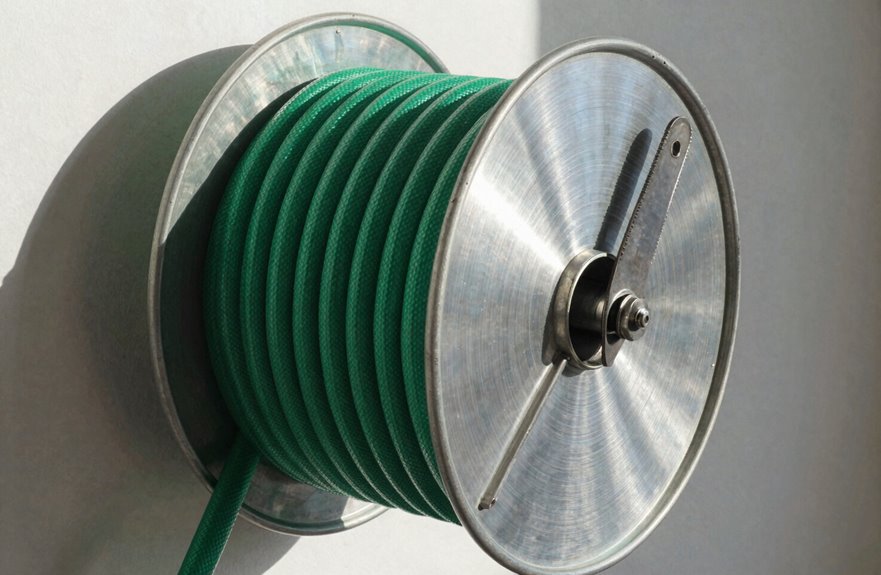
Picture the hose guide as your reel’s traffic cop, directing that rubber line exactly where it needs to go so it doesn’t pile up like laundry on a teenager’s floor. The guide rollers, usually two-inch diameter nylon wheels and sometimes steel for industrial setups, press gently against the hose as it retracts, forcing it to lay in tight, even rows from one drum flange to the other. When everything’s aligned right, you’ll get that satisfying “thwap-thwap-thwap” rhythm of perfect layering. Get it wrong, and you’re looking at a bird’s nest that’ll kink your hose in six months flat.
Guide Roller Function
Although it might seem like a simple piece of hardware, the guide roller is actually a critical component keeping your hose from turning into a tangled disaster every time you hit that rewind button. This component functions as a traffic controller, managing that winding path so everything stays neat.
Here’s what happens when a hose guide operates:
- The curved surface cradles your hose like a gentle hand, guiding it away from sharp edges and preventing fraying.
- It maintains consistent spacing between wraps, building even layers across the drum.
- The angled profile accommodates different hose diameters, whether you’re running ½-inch garden line or ¾-inch contractor grade.
The hose guide reduces friction, prevents tangles, and keeps your rewind smooth.
Alignment During Retraction
Because the hose’s natural instinct is to wander like a distracted puppy, proper alignment during retraction is critical to performance.
Guides do the heavy lifting here. They keep the hose tracking straight toward the drum’s edges, which stops that annoying side-to-side drift when tension shifts. The moment when winding goes from smooth to spaghetti nightmare is exactly what rotating guide arms prevent as hose lengths change.
The alignment these guides maintain ensures even winding across every layer. No bunching, no gaps. They preserve a consistent bend radius too, so you’re not fighting kinks that’ll trip you up later. Getting this right means your hose wears evenly and maintains its structural integrity over time.
Preventing Hose Damage
Getting your hose to wind up neatly is only half the battle. The real goal is keeping your investment alive season after season, and that’s where hose guides earn their keep.
Picture this:
- A rigid arm (or roller set) steering your hose into a winding path that spirals perfectly, with no overlaps and no spaghetti pile.
- That same guide holding the angle steady so torsional stress doesn’t twist your hose lining prematurely.
- The drum edge staying friendly with no sharp bend, because cracking starts there and spreads quickly.
I’ve seen too many connectors stripped and too many linings worn from bad alignment. Adjustable guides, particularly the multi-roller type for mixed diameters, keep tension even. This prevents hose damage rather than leaving it as a certainty in your trash can.
Manual Crank Hose Reels: Simple and Reliable
Why do I still love my manual crank reel after fifteen years of use? It’s the satisfying click of the winding mechanism, the way my hand guides the hose onto the reel drum with zero fuss. No batteries, no springs. Just me, the manual crank, and a perfectly coiled hose every time.
These reels work through five key components:
| Component | What It Does | My Pro Tip |
|---|---|---|
| Manual crank | Turns the spindle to wind your hose | Crank slowly for even layers |
| Reel drum | Holds 100+ feet of hose (usually) | Check for rust annually |
| Winding mechanism | Transfers crank motion to rotation | Lubricate yearly with silicone |
| Spindle | Central axis the drum spins on | Listen for grinding noises |
| Hose guide | Keeps coils neat and tangle-free | Adjust if hose bunches on one side |
I pull the hose out, water my garden, then reverse the crank. Simple. Reliable. Effective.
Spring-Driven Hose Reels: Automatic Retraction Explained
How exactly does a spring-driven reel pull that hose back in without you lifting a finger? This mechanism feels like magic until you examine what’s inside.
Here’s what’s happening while you’re working:
A flat steel spring winds tighter with each pull, storing energy like a drawn bow until you’re ready to release it.
- You pull the hose outward, and that flat steel spring, a giant metal ribbon about 1-inch wide, winds tighter around the axle and stores energy like a drawn bow.
- The ratchet-latch mechanism clicks into place, holding your desired length so you’re not fighting tension while watering.
- When you’ve finished, you give a gentle tug to release the latch, and that pent-up spring energy converts to smooth, automatic rotation; the drum rewinds without your help.
Spring-driven retraction requires no cranking or manual effort. The mechanism delivers controlled, consistent winding every time you use it.
What Happens During a Spring Retraction Cycle?
When you tug that wound hose outward, you’re winding up a flat steel spring (think of it like a giant clock spring, about 1/16-inch thick) around the central axle. The spring stores mechanical energy, waiting in a state of potential until a ratchet latch clicks into place, holding your hose at exactly 17 feet, 23 feet, or whatever length you need.
Release that latch, and the stored energy converts to rotational force, spinning the coaxial drum at roughly 60 RPM. A guide arm keeps everything aligned, so your hose rewinds smoothly without tangles or complications.
Motorized Hose Reels: Electric vs. Pneumatic Power
Motorized reels swap out that clock-spring guts for honest-to-goodness motors. There’s something deeply satisfying about hitting a button and watching fifty feet of garden spaghetti vanish in thirty seconds flat.
You’ve got two main flavors here:
- Electric: AC or DC motors power smooth retraction in shops and garages where you’ve got outlets handy. Flip the switch and you’re done.
- Pneumatic: Compressed air drives spark-free motor operation for hazardous zones, such as chemical plants or gas stations.
- The mechanics: Either way, that motor spins a gearbox and drum, pulling hose while a swivel joint keeps water flowing.
Hydraulic motors exist too, by the way. They deliver maximum pulling power for industrial hose applications. Most users won’t need that capability. Safety features like overload protection and emergency stops come standard.
How Hose Reel Mounting Position Affects Performance
Where you mount that reel significantly affects performance. I’ve mounted reels in multiple locations: ceiling, wall, and post. Each mounting position changes how the reel mechanism performs.
Wall mounts save floor space and prevent tripping hazards, but they limit vertical reach where your hose meets the source. Ceiling mounts elevate everything away from the work area, providing safety in busy workshops, though accessing the reel requires a ladder.
Your mounting position directly stresses the swivel joint differently. Poor leverage from incorrect angles reduces retraction smoothness. The snap-back becomes jerky and rough. The guide system wears unevenly as a result.
Selecting the proper mounting position extends your hose lifespan by several years.
How Hose Reels Manage High-Pressure Water and Air
Why does pressure turn a simple garden tool into something that demands respect? Because 3,000 psi (pounds per square inch, for context) isn’t forgiving, and experience shows this is a lesson worth learning.
Pressure transforms the ordinary into the unforgiving—3,000 psi teaches respect through experience.
A high-pressure hose reel earns its keep through three critical features:
- Reinforced drums, often stainless or powder-coated steel, that won’t warp under extreme force
- Swivel joints rated for watertight rotation, so you’re not fighting kinks mid-job
- A retraction mechanism, think sturdy spring-driven reel or motorized drive, that handles tension without binding
Compatibility checks are essential: rubber or polyurethane hoses, proper flow rates, no shortcuts. Corrosion-resistant materials matter too, especially with chemical exposure. When your spring-driven reel snaps back smoothly and those swivel joints keep spinning free, you have gear designed to perform in demanding workflows.
Maintenance That Extends Hose Reel Lifespan
The quiet satisfaction of a reel that pulls smooth every time is what I’m after, and maintenance gets me there without breaking the bank or my patience.
I check my spring-driven retraction mechanism every three months. A dry torsion spring, the flat steel coil storing your pull-back energy, will snap, so I hit it with white lithium grease. Two light coats work best, and I work the hose in and out three times to distribute. For the winding system, I inspect the drum axle for grit. Five minutes with a shop rag prevents scored metal. The ratchet latch needs one drop of 3-in-1 oil where the pawl meets the gear, you’ll hear the click that marks your spot. I replace guide arm rollers when they wobble, not when they seize. This simple maintenance routine delivers years of reliable service.