
These ideas run from a single afternoon with paint and found rocks to the years it takes for wisteria to drape a porch, so the deciding factor is how long you can wait before the look arrives.
A weekend timeline gets you painted fences, fairy lights, and bottle displays; patience gets you self-seeding lupines and a secret garden enclosed in climbing vine.
A wire birdcage planter costs next to nothing at a flea market, while the thatched-roof cottage needs a permit check and a gravel base before you even order materials.
1. Cottage Garden Whimsy Lane

A cottage garden whimsy lane works best when the path gives your eye somewhere to land while the plantings do whatever they want.
The low hedging here, probably boxwood or a slow-growing shrub, is what makes the chaos readable; without that green edge, the flowers just read as overgrown.
I would check my soil drainage before planting the hedging, since wet feet will kill the structure faster than any perennial misbehavior.
Brick set in sand is forgiving if you need to lift and reset a section later, which you probably will as the beds bulk up.
2. Painted Fences

Painted fences are the fastest way to turn a plain boundary into something that reads as intentional folk art rather than maintenance neglect.
The black base here is doing real work; it makes the bright colors pop without reading as childish, and it hides the grime that collects on lower pickets.
I would use exterior acrylic, not craft paint, and plan on a clear coat if the fence gets direct afternoon sun.
The insects and flowers are simple shapes, nothing that requires drawing skill, just a steady hand and a small brush for the outlines.
3. Fairy Lights
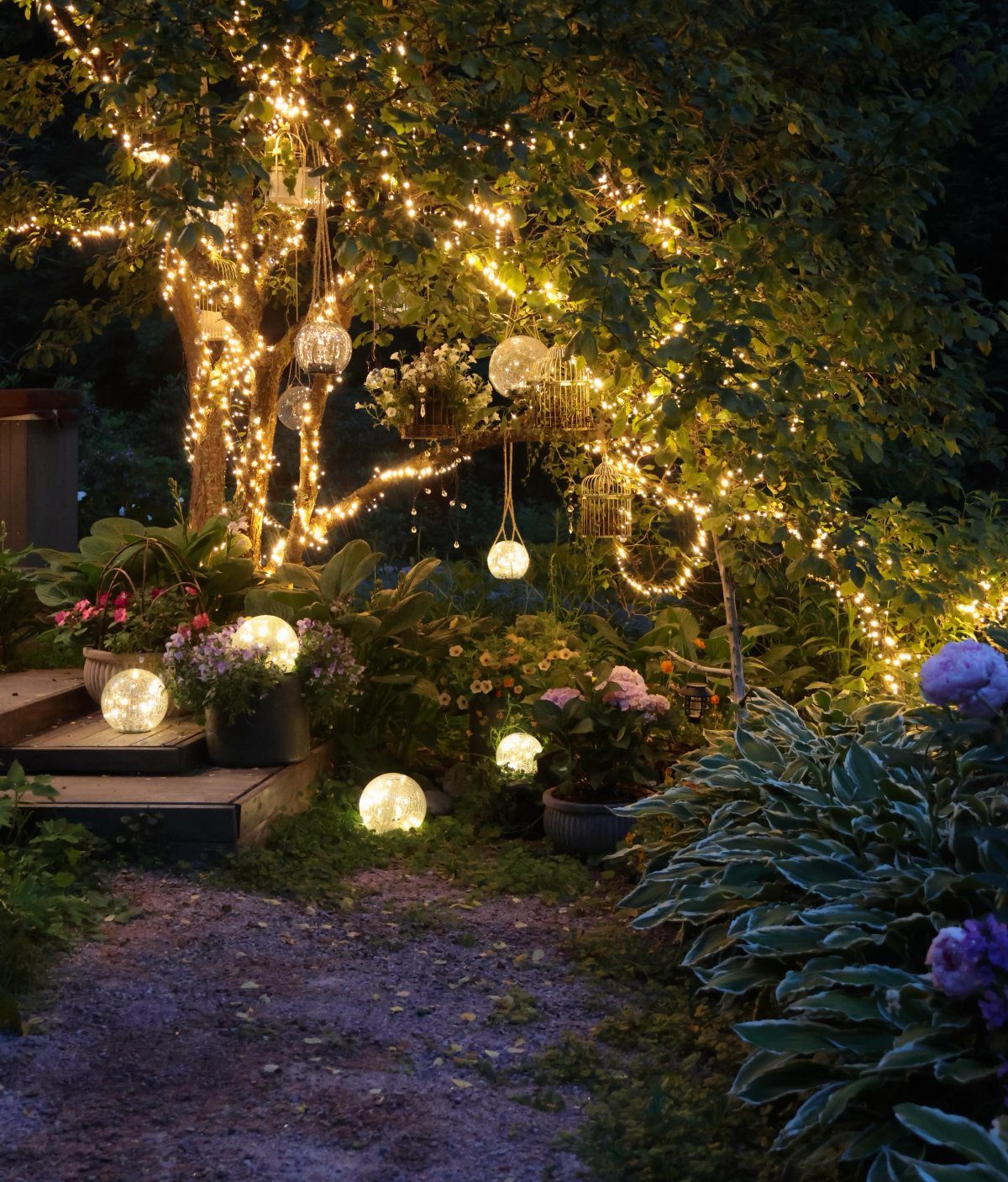
Fairy lights shift a garden from daytime use to something you want to walk through after dinner, which is where I get most of my actual sitting time anyway.
The mix here matters: wrapped tree trunks give height, hanging lanterns give pools of light at eye level, and the small spheres tucked into pots keep the ground plane from going dark.
I would put everything on a timer or smart plug rather than trusting myself to remember, and I would buy the plug-in kind over battery for anything that stays up more than a month.
The warm white is the choice; cool white reads as security lighting and kills the mood entirely.
4. Decorative Rocks
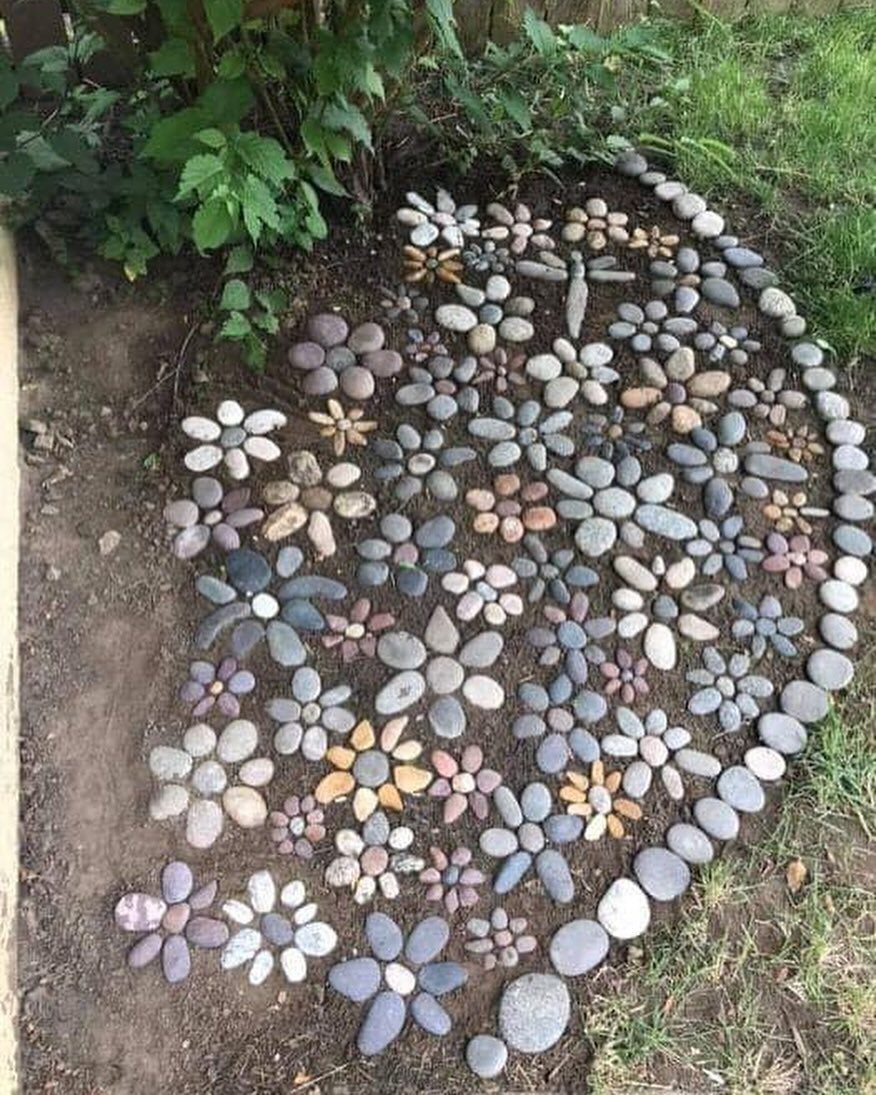
Decorative rocks are one of those ideas that looks effortless and takes longer than you think, mostly because getting the stones to sit flush without rocking takes patience.
Smooth river rock set into bare soil or very short turf works for these flower shapes; the dragonfly needs a longer central stone for the body and smaller graduated ones for the wings.
I would lay out the whole pattern before I started pressing anything in, and I would work after rain or water the ground soft, since dry dirt fights you.
This is a weekend project that costs whatever the stones run locally if you buy them, or nothing if you collect your own from riverbeds or a friend’s field.
5. Whimsical Garden Path

A whimsical garden path lives or dies on the contrast between its materials, and the black and white pebbles here are doing that job against the pale stepping stones.
The overturned pot spilling stones is the detail that makes it feel found rather than installed; I would copy that directly, maybe with a cracked pot I already have.
The circular stones look like precast concrete, which saves the cutting that natural flagstone would need.
I would set them with a slight crown so water runs off, and I would keep the pebble border shallow, just enough to cover the edging, or you will be raking them back into place every time you mow.
6. Water Features

Water features sound like a big commitment, but a bubbling basin on gravel is about as low-stakes as they get; no pond to clean, no fish to keep alive, just a small recirculating pump and somewhere to plug it in.
Floating lemons are a cheap seasonal touch that reads as cheerful rather than precious, and they mask the pump housing if you do not love the black plastic look.
I would check that the stone is sealed or dense enough not to weep, since hard water stains will build fast in sun.
A pump rated for the basin volume is what you want; too strong and you get splatter, too weak and it reads as broken.
7. Secret Garden

A secret garden only works if the enclosure reads as accidental, not built for privacy fencing. The arched doorway here is the critical piece; without that framed entry, the space would feel walled off rather than discovered.
I would check that my vine choice matches my patience, since wisteria or ivy this thick starts small and fills in slowly, while clematis would fill faster but need more cutting back.
The round pond needs level ground and a pump outlet within reach; extension cords across lawn are a trip hazard and an eyesore.
Stone set dry, not mortared, lets you lift and reset as roots shift the ground over the seasons.
8. Cottage Garden Wildflower Planting

Self-seeding wildflowers save you the replanting that annual beds demand, but the first year is mostly dirt and hope while the roots establish.
The circular lawn here acts as a breathing space; without that negative shape, the flowers would read as unkempt rather than intentional.
I would choose a regional mix over generic "wildflower" seed, since what self-seeds depends on what survives your winters, and a mix bred for another zone leaves you with expensive mulch.
The stone path needs to sit slightly above grade or the plants will colonize it by August. Mow the lawn edge clean twice a month; that sharp line is what makes the rest look chosen.
9. Birdcage Hanging Basket

A wire birdcage turned planter gives you the structure of a hanging basket without the plastic look, and the openwork means drainage is built in.
A black finish hides the soil line and lets the flowers read as the whole show; a white or brass cage would compete.
I would line the bottom and halfway up the sides with coconut fiber or sheet moss to hold the potting mix, and I would still use a plastic liner with drainage holes cut in, since dry moss sheds soil every time you water.
The chain it hangs from needs to be rated for wet soil weight; a full cage gets heavy fast, and a decorative hook that looks right may not hold it.
10. Weed Bouquets

Cutting what grows uninvited and calling it a bouquet is free, and the mix of heights and shapes often looks looser than store-bought stems.
Queen Anne’s lace and cornflowers here are technically escaped cultivars, not true weeds in most states, so I would check my local noxious plant list before I gathered anything I did not plant myself.
The armful reads as generous because the stems are long and leaf-heavy; that means cutting low and stripping lower foliage so the water line stays clean.
I would use a jar, not a vase with a narrow neck, since the stems are irregular and the heads heavy. Change the water daily; roadside or lawn plants carry more bacteria than nursery stock.
11. Wisteria Porch Reverie

Wisteria this established takes years to build, not a weekend project, so the house color and trim need to please you on their own for a good long while.
The white here is the right neutral; anything warmer would yellow against the purple bloom, and anything darker would swallow the shadow the vine casts.
I would check my porch framing before I let anything climb; wisteria twines tight and thickens to rope-size, and it will pry apart loose boards or lift flashing.
The dining set on the lawn is the practical choice, since the falling bloom and bee traffic directly under the vine make seated eating there a short-season pleasure.
Prune hard in late winter, again after bloom, or you own a green shag carpet, not a draped flower.
12. Fairy Garden Feature

A miniature garden in a bed rather than a container lets you use larger pieces without the scale feeling wrong, but it also means the weather gets at everything.
The stone cottage here is probably resin or hypertufa, not actual stone, since weight matters when you are resetting after rain washout.
I would set the pebble path on sand, not glue it, so I could lift and relevel after the ground settles; a frozen glued path cracks or heaves.
The red toadstools are the accent that reads as whimsical rather than model-railroad serious; I would limit myself to one repeated accent color or the scene goes cluttered fast.
This suits a corner you see from above, not ground-level viewing, since the perspective is built for a downward look.
13. Upcycled Garden Decor

Vintage tins with their printed flowers still showing, plus silverware that catches the light, give you wind chimes that read as found objects rather than craft-store kits.
A branch or driftwood piece can do the same structural work if you prefer not to build a wooden stand.
I would check that my drill bit matches the tin metal, since a bit meant for wood will walk and tear the printed surface.
The beads need holes large enough for whatever cord I use, and I would use fishing line or thin wire, not yarn, since rain rots fiber fast.
Weight matters; too heavy a fork and the tin lip it hangs from will bend over a season.
14. Wind Catchers

A flower-shaped spinner breaks up a flat lawn in a way static sculpture does not, and the rainbow stripes read as cheerful from a distance without demanding a color scheme from the rest of your planting.
The stake needs to go deep enough that the blade does not tilt under wind; I would wiggle it hard after setting to check.
A separate hub piece for the center lets the petals catch from any angle, which works better than a single fixed blade.
I would place it where it gets sun from the side, not head-on, since the color shifts as it turns and that motion is the whole point.
A single spinner looks lonely; two or three at different heights carry the idea better.
15. Stackable Ceramic Garden Totems

Stacked ceramic totems give you height in a bed without waiting for a shrub to grow, and the glazed surfaces hold up to weather better than raw clay would.
Flat bases and tops on each piece mean you can skip the center rod for light figurines like these, though I would still run a metal stake up the middle if my ground is soft or my area gets wind.
The colors are saturated, which is why they read from across the yard; a muted palette would disappear against green foliage.
I would check that the bottom piece is the heaviest and widest, or the whole thing wobbles like a diner sign.
16. Wire Mesh Topiary Sculptures

Wire mesh forms let you shape greenery into figures without learning to clip topiary, and the rabbit and turtle here are probably stuffed with sphagnum moss and planted with small-rooted trailers like sedum or creeping jenny.
The mesh is the support system, not the visual; I would choose dark green or black over silver, since the eye reads the plant, not the armature.
The woman setting them is wearing gloves, which makes sense; the cut ends of hardware cloth or chicken wire are sharp enough to draw blood.
I would sink the base a few inches into turf and peg it, or a hard rain will lean your rabbit. These suit a flat lawn you see from a window, not a slope where the perspective goes wrong.
17. Hanging Teacup Planters

Teacups as planters trade the usual terracotta for something that reads as collected over time, and the mix of patterns here works because the plants inside are all the same green, which unifies what the cups would not.
The hooks need to screw into solid wood, not just the surface layer of a beam, since wet soil in ceramic gets heavy; I would check my beam for rot before I trusted it with 4 cups.
Teacups hold water, so I would keep the soil barely moist and choose herbs that tolerate damp feet, like mint, over ones that want dry roots, like rosemary.
A saucer under each cup would ruin the look, so I would skip those and water with a light hand.
18. Hand-Painted Bottle Plant Display

Hand-painted bottles on a shelf give you a display that changes with whatever cuttings you have, and the narrow necks hold a single stem upright without florist foam or wire.
The painting here is bright and simple, not detailed, which is the skill level most of us actually have; I would use acrylic and seal it with a clear coat if the shelf gets rain.
The metal shelf is powder-coated white, which reflects light back through the glass; a dark shelf would swallow the colors. I would check that my bottles are thick enough not to crack in freeze-thaw, since thin decorative glass will shatter.
The cuttings root in water, so I would change it weekly and watch for cloudiness, which means bacteria and a stem that will rot before it roots.
19. Thatched-Roof Storybook Cottage

A thatched-roof garden cottage is a shed built for charm rather than storage, and the rounded roof line here is what sells the fairy-tale look; a standard gable would read as ordinary outbuilding.
Lupines surrounding it are tall perennials that self-seed once established, so the first year is planting and the second year brings full color with no replanting.
Checking local building codes before ordering anything is worth the time; a structure with a footprint over a certain size needs a permit even if it has no foundation, and that threshold varies by county.
The thatch is likely synthetic reed, not actual straw, since real thatch needs a steep pitch and specialized labor most regions do not have. Synthetic lasts decades with no maintenance beyond hosing off pollen.
I would set it on compacted gravel, not a concrete pad, so I could move or relevel it later; a permanent foundation turns a whimsical piece into a taxable structure in most jurisdictions.
Creating a Whimsical Atmosphere
A whimsical garden lives in the tension between loose and held.
The informality is what draws you in, but it only reads as intentional if something anchors it: a path, a repeated color, a frame like that arched doorway. Without that anchor, the eye registers neglect instead of play.
The nostalgia piece matters more than most people admit. What feels whimsical to me, a soft romantic tangle of old roses, might strike you as cluttered or too tame.
Neither is wrong. The personal root is what separates this from a style you copied.
I would start by naming what I actually loved as a child: a grandmother’s crowded borders, a neighbor’s wind chimes, a book illustration. That memory becomes the filter for every choice after.
Movement and surprise need staging.
A flower spilling where it should not is only charming if the path itself is clear enough to walk. Sightlines matter from the spots where I actually sit, not from the center of the yard where I never stand.
A whimsical garden shouldn’t be tightly controlled like the reins of a horse, but rather as the award winning garden designer Ann-Marie Powell explains: ‘A whimsy garden is spontaneity made visible. It’s surprise, delight, those moments that make you smile without quite knowing why.
Plant Selection
The plant list for this look runs toward old-fashioned blooms with soft stems and heavy scent: foxglove, hollyhock, lavender, the ones that lean and self-seed.
Airy fillers like cosmos or gaura give the movement that stiff perennials cannot; without them the bed reads as a border, not a drift.
Pollinator traffic is part of the sensory design, not a side benefit.
The hum and flicker turn a still garden into something happening in real time. I would include something blooming in each month from May through September, since an empty August bed kills the mood faster than any weed.
Texture from hard materials matters as much as foliage.
Curved lines against straight beds, round stones against rectangular pavers: the contrast is what keeps informal from looking accidental. I would mix gravel near paths with bark in beds, not blended but adjacent, so each reads as its own zone.
Fragrant plants near seating are the detail most people skip. A jasmine or nicotiana by the chair you sit in after work does more than a whole border of it by the fence you never reach.
Budget-Friendly Ideas
Limbs down after wind, rocks pushed up by frost, a broken pot: these are the bones of whimsy before you spend anything.
I would set my found stones in a small pile with seed scattered around, not arranged like a display, and let the plants colonize the gaps.
Teacups and vintage ladders are the classic upcycles for a reason.
The cup gives you instant vintage charm; the ladder gives vertical space without building a trellis. Thrift stores in spring, when estate clearouts hit, beat buying distressed reproductions at garden-center prices.
Painted rocks and DIY fairy houses cost acrylic and time.
The skill level is low; the patience level is what separates the ones that stay from the ones that wash out by July. I would seal anything that sits on soil, since ground moisture wicks up and blurs the paint.
Pallet vertical gardens work if the pallet is heat-treated, not chemically treated; the stamp "HT" means safe for vegetables, and by extension for anything you handle often.
I would line with landscape fabric and pack tight with soil, since loose fill settles and leaves gaps at the top by August.
Family projects are a real budget stretcher if you count time as money, but not if you count them as the reason you finished.
A five-year-old hunting rocks for Nana’s border is cheaper than any purchased ornament, and the story outlasts the paint.